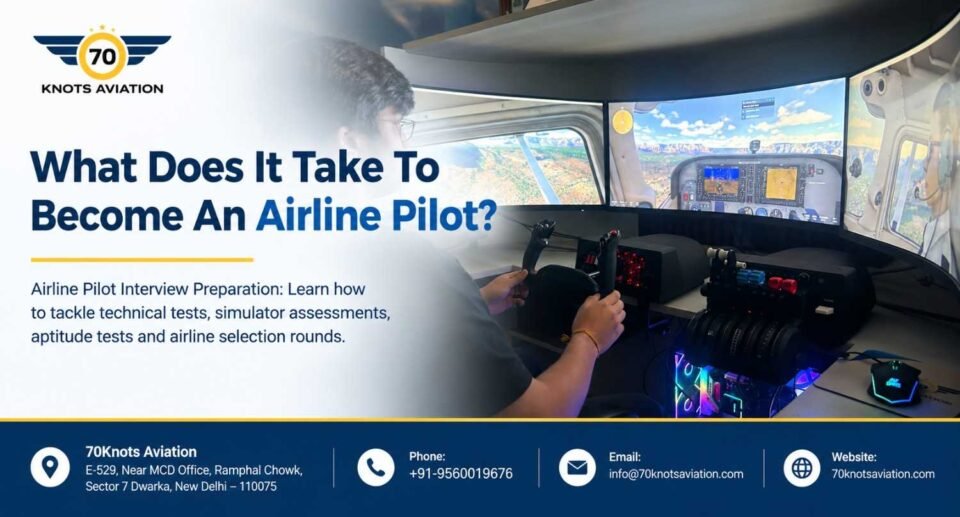
What Does It Take To Become An Airline Pilot?
The path from flight training to your first job as a professional pilot is a long and winding one, and the entire process can take years. Part of this involves a series of assessments conducted by a number of different airlines. There are many different things that you need to prepare for, beyond simply memorizing your aviation subjects. These include things like your judgement, communication and general awareness of the airline that you are applying to.
The best way to prepare is to take a structured approach. This means taking the time to understand the various areas that you may be assessed on, identify your gaps and practice explaining the concepts in a clear manner. This is where an organization like 70Knots Aviation can help. 70Knots has extensive knowledge of aviation and can help students shape their professional preparation in a clearer and more structured way.
Build Your Technical Knowledge
Technical interviews are quite common in the world of aviation. This means that, as a candidate, you need to feel prepared to give a thorough answer to revise subjects like Air Navigation, Meteorology, Air Regulations, and other related subjects.
Preparing for an interview means that you need to know your stuff. It is possible that interviewers may test your knowledge of a subject to the point of applying the knowledge to a situation or giving an example of why a particular action is performed. You should also know the reason behind your answers rather than relying on rote memorization. It is better to constantly revise using different mediums (notes, practice tests, explanations) to truly know the subject rather than memorizing isolated answers. At 70Knots Aviation, ground training forms the basis of aviation concepts and helps guests gain more confidence in talking about them.
Learn to Explain Your Knowledge
Getting the right answer is only part of the interview for pilots. They must also be able to communicate information clearly and calmly. Airline interviewers observe how candidates construct their responses, listen to questions, and clarify technical information.
Practice answering questions out loud. Be aware that the use of industry jargon and long, complicated phrases can make answers unnecessarily difficult to follow, even if they are technically correct. Using plain language is important when discussing operational information.
Learn About the Company
Students preparing for an interview should research the airline. Candidates should become familiar with the airline’s routes, fleet, and general business model. Understanding a particular airline’s culture and current operations can help articulate to the interviewer why they are interested in that airline in particular.
Preparing answers in this way can also illustrate an understanding of context to the interviewer and show an interest in the specific opportunities available rather than treating the interview as a generic part of the pilot recruitment process.
Carefully Plan Your CV
Pilot CVs should provide a chronological account of a candidate’s flying experience, achievements, and other relevant information. Care should be taken to check the accuracy of dates, licenses, and ratings, and flying hours.
Interviewers will want to explore items on your CV in more detail. It is a good idea to familiarize yourself with the various elements of your CV, as an interviewer may ask about training, a particular aircraft type, a qualification or a particular time in your career. Your CV is a basis for discussion, not a document you simply hand in before the interview.
Anticipate Different Types Of Interview
Interviews can take many forms and may involve several stages of assessment. Depending on the airline, you may be required to complete online written tests covering English, mathematics, reasoning and technical knowledge, followed by psychomotor and aptitude tests, such as CASS-type coordination and multitasking assessments. You may also undergo psychometric and personality tests to evaluate your decision-making, behaviour and suitability for the role. Some airlines include a group discussion to assess communication and teamwork skills. One of the most challenging stages is often the simulator assessment (sim check), which evaluates your flying skills, aircraft handling and ability to perform under pressure.
A candidate should therefore prepare for several different styles of questioning. There may also be a range of formats covering shorter, factual questions, as well as longer questions that require you to elaborate on a past experience or justify a previous decision.
Assess Your Approach
There are many types of questions that help assess a candidate’s approach to situations in terms of safety and working with others, as well as their decision-making and communication. When answering these questions, you should be prepared to explain how you would assess a situation and describe the actions you would take to address any issues. You should avoid providing an answer that suggests you would be someone who disregards procedure to try and resolve an issue.
Answer Realistically
Student: What should I focus on first if I have an airline interview coming up?
Counsellor: Focus first on subjects you find difficult and explain those topics to yourself. Don’t just read your notes.
Student: What if I’m able to find the correct answer, but am unable to verbalize it?
Counsellor: This is exactly what practicing verbally is for. Take a technical question and provide your answer as if speaking to an interviewer. Try to keep your response concise and only talk about what is necessary to answer the question.
Student: Will they ask mostly technical questions?
Counsellor: Not always. You should also practice for questions about teamwork, decision-making, communication, and professionalism, as well as situations you may have encountered while you were training.
Student: Is there anything else I can do to practice communication?
Counsellor: Practice communicating by explaining things to another person. Have that person cut you off if they feel your communication is unclear or too long. Students at 70Knots Aviation are also able to use their classroom discussions to practice communicating knowledge of aviation and related fields.
Student: Is it useful to memorize the answers to common interview questions?
Counsellor: Understanding the answer is more beneficial than memorising it. It is also important to practise communicating your thoughts clearly and confidently. Preparing the main points of an answer and expressing them in your own words is more effective than memorising complete responses.
Create a Pre-Interview Routine
Candidates can improve their interview preparation by incorporating technical revision, research on potential employers, communicaiton practice, and mock interview sessions. They can also organize their sessions based on aviation topics, competency-based and/or training questions.
The unknown and pressure are what’s most important to the success of a mock interview. 70Knots Aviation likes its students to build their confidence via their understanding of the subject matter as opposed to rote memorization.
How to Become a Pilot: What Lies Beyond Flight Training
Pilots-to-be spend the early stages of their journey researching how to become a pilot by learning about eligibility, medical fitness, and the training and flight requirements. These are vital parts of the journey, but professional preparation also means inculcating the habits of a working pilot.
This includes preparing for interviews. Candidates should build technical and interpersonal discipline and acumen which would enable them to properly evaluate and answer questions in a more rounded and considerate manner. The goal is to have the level of understanding to appropriately provide an answer as opposed to trying to craft an answer to an anticipated question.
Stay Grounded and Realistic
It’s important to stay grounded and realistic. Confidence should come from proper preparation as opposed to being over-confident. A pilot should be willing to state “I don’t know” as opposed to providing an incorrect response. It’s vital that judgement and procedure govern the approach in the field of aviation and should similarly govern the approach in an interview.
Preparation does not always yield the result desired. Each airline has its own process, standards and requirements. The aim should be to properly present your experience and professional qualities.
Questions Students Commonly Ask
1. How far in advance should I prepare for an airline interview?
Prepare as far in advance as possible. Several weeks of advanced preparation can help cover last-minute interview jitters, provide time to study and revise subjects and review airline specific information, and perform several structured practice interviews.
2. Are airline technical interview questions difficult?
The technical interview questions can vary by airline and assessments. Logical application of aviation theory is a key element, but candidates should expect questions concerning general aviation knowledge as well.
3. How can I improve the communication in my interviews?
Practice speaking clearly and directly. Keeping your answers around the 30 second mark is a good benchmark. Long, unclear responses can be caused by rushing.
4. Should I memorize answers to airline interviews?
Understanding the points you want to communicate is important. If you’re not familiar with the topic, memorizing the answers won’t help if the question is outside the scope of the memorization.
5. Is good preparation for interviews enough to get selected?
Not always. An interview, to some extent, helps a candidate prepare to arrange his/her thoughts in an organized way to present before the assessors. However, selection is always decided by the airline’s recruitment team, their assessment criteria, and the candidate’s performance.
Prepare With Purpose
Preparing for an airline interview is essentially preparing for an evaluation of one’s complete pilot training. This includes one’s technical skills, interpersonal skills, and ability to work with others. Of course, candidates are always better prepared to take up a process with a clear understanding of what’s involved.
70Knots Aviation provides interview preparation workshops. However, interview preparation should focus on enabling the candidate with the tools required to have an in-depth understanding of what is required of them and of the profession of piloting, as well as promote real practice and professional preparedness, as opposed to preparing to answer a set of predetermined interview questions.
You might also find this blog useful:
The 70Knots Aviation team shares informative and practical insights on pilot training, aviation careers, DGCA requirements, CPL training, flight training, and the Indian aviation industry. Through well-researched articles, the team aims to help aspiring pilots, aviation students, and aviation enthusiasts understand training pathways, eligibility, courses, and career opportunities in aviation. As one of the best pilot training institutes in India, 70Knots Aviation provides clear and useful information to support readers at every stage of their journey toward a career in the skies. With a focus on practical aviation knowledge, the team brings together valuable insights to help readers make informed decisions about their aviation education and career.