
Understanding DGCA Medical Requirements for Pilots

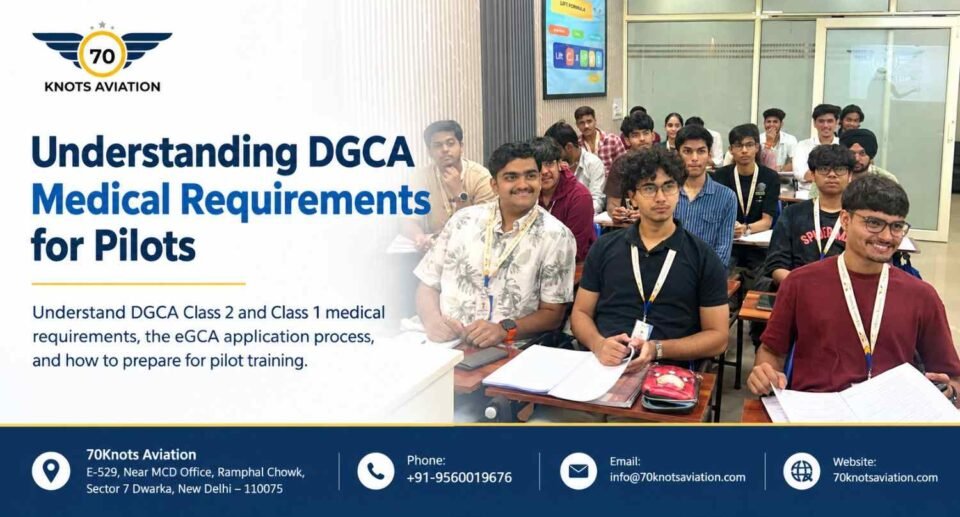
Apart from being able to learn how to fly as well as take exams for the field of aviation, there are some other things that a professional pilot has to think about in terms of their qualification. It is very important that all aspiring pilots know something about the medical part of their qualification from the beginning of their career.
While many students pursuing a career in aviation are interested in ‘how to become a pilot’ and focus on the flying and academic requirements, understanding the medical process early on can help students structure and plan their training more effectively. The medical process should not be an afterthought at the end of the training. It should be part of the initial planning process.
Why is the DGCA Medical Important?
In order to be employed as a professional pilot, one has to comply with the medical standards set by the aviation regulator. A DGCA medical examination determines an applicant’s eligibility to be issued a pilot’s license.
This means that from the very early stages of a career in aviation, one has to consider medical standards. Students who wish to pursue a career in aviation should be made aware of the medical requirements and standards. This knowledge can aid students to take more informed decisions during their training.
Students at 70Knots Aviation are encouraged to take the medical process as part and parcel of the training process. There can be variations in the medical requirements and standards for different pilot licenses and ratings, and students should consult current DGCA guidelines and a DGCA-approved medical examiner for specific information.
Understand the Medical Requirement Before Booking
You should understand which medical assessment you need before booking a medical examination. Different medical assessments apply to different stages of pilot training. Therefore, assuming that you only need to go through one medical examination for all future pilot training is incorrect.
There are two types of medical tests which are necessary for any prospective pilot:
- Class 2 medical
- Initial Class 1 medical
Class 2 medical: The test should be done before the start of flight training and must be carried out by an approved Class 2 medical examiner of DGCA.
Initial Class 1 medical: This test is necessary for getting a Commercial Pilot License (CPL). This test must be done at an approved Class 1 centre or by an approved Class 1 medical examiner of DGCA. Class 1 medical tests have to be done periodically for professional flying.
Applications for both Class 2 and initial Class 1 medical assessments are made through the eGCA portal. Students should check the latest DGCA instructions for the application process and appointment requirements before proceeding.
Students should check the latest information published on the DGCA website and understand if they require an initial assessment, a class of medical examination or if they may need further assessment later on. It is always advisable to confirm any ambiguity with a DGCA-approved medical examiner before taking any decision.
Students that are training through 70Knots Aviation can utilize the training plan to consolidate queries on the medical stage and proceed further with confidence for other stages of their aviation career.
Prepare the Required Documents
A good way to prepare for the assessment is to organize the required documents for the assessment well in advance. What documents are required may depend on the class of medical assessment, the DGCA process, and what the medical examiner determines to be necessary. Students are advised to check the latest process instructions published by the DGCA.
Based on the process, students may be required to submit their identification documents, medical records/reports, photographs, and other documents. Students should confirm that details on their documents are consistent. It is always advisable to follow the instructions of the DGCA process and medical examiners.
What to Expect during the Examination?
DGCA medical examinations evaluate certain aspects of an individual’s health and fitness related to the performance of duties of an aeroplane pilot. The nature and extent of the examinations and tests would depend on the medical category and individual’s circumstances.
Students are requested not to compare their appointment to that of others as one individual’s examination may require different assessments to another’s.
Generally the best approach is to bring all the documents requested, follow the instructions of the medical centre and provide correct responses to questions. If further assessment and/or documentation is required, students are advised to seek the professional guidance of the DGCA-approved medical examiner rather than relying on suggestions of friends and/or online forums.
Do Not Procrastinate Medical Related Things
Because there are many different stages to the training to become a pilot, it is a good idea to start thinking about medical related things early on, because if you leave things until the last minute, it can affect your plans.
This does not mean students should be anxious about the examination; rather it means, students should be proactive and take a serious view about medical aspects related to their career as a pilot.
For students looking to do a Commercial pilot training in India, it is particularly important to consider medical planning, because becoming a commercial pilot involves a considerable amount of investment both in terms of time, effort and money. Knowing the medical pathways can help students plan their training responsibly.
Medical Requirements
Keep in mind that medical requirements can be changed and information found in social media or older websites may not be up to date. Always refer to the latest instructions and materials uploaded on the DGCA website for regulatory requirements.
For health-related queries, a DGCA-approved medical examiner is the right person for guidance. A training institute can help students understand the sequence of pilot training, but they should not replace medical professionals for giving medical advice.
70Knots Aviation is always ready to help students understand where the medical aspects of training fit into their wider training plan. Students, however, should always seek a DGCA-approved medical examiner for guidance on health aspects of the DGCA medical examinations.
A Student Talks To A Counsellor
Student: I am preparing for my first DGCA medical and I do not know what to expect and what to do prior to the appointment.
Counsellor: First of all, check DGCA requirements for the medical assessment and see what documents you need. Follow instructions of the DGCA-approved medical examiner.
Student: Should I wait to do the medical assessment until I begin my flight training?
Counsellor: There are medical assessment requirements for you even before you begin flight training. It is useful to make plans for the medical assessment and overall pilot training as early as possible, in order to be in control of your overall training plans.
Student: What happens during the assessment? I have seen different things on the internet.
Counsellor: That is pretty standard, but individual situations can vary. Use the current DGCA guidance and the DGCA-approved medical examiner doing your assessment if you have any questions.
Student: So I don’t have to worry about that?
Counsellor: Worry isn’t the right word. You just need to know the process and show up with the right docs. The rest is about following the instructions from the medical centre and providing the right info. You don’t have to rely on checklists or rumours.
Student: That actually clarifies a lot.
Counsellor: You should view your medical as an important part of your training. Plan your medical assessments along your aviation training.
Questions Students Commonly Ask
1. When should I start thinking about my DGCA medical?
It is crucial for you to think about your DGCA medical from an early stage in planning your pilot training. It depends on your individual case when exactly to do it, so please refer to the relevant DGCA manual and/or consult a DGCA-approved medical examiner.
2. What documents should I take to my first medical?
The documents you will need to take will vary based on what kind of exam you will be taking and what the current DGCA processes are. Check the most recent info and be sure to provide all ID that is applicable, your completed application and any other documents that are requested.
3. Can I rely on what another student has told me about their medical?
What another student tells you can help you with general information, but you can’t rely on that for official information. Be sure to check the most current DGCA info and consult the DGCA-approved medical examiner doing your assessment.
4. How will it be if the medical examiner needs more test results or reports?
Follow the instructions of the DGCA-approved medical examiner. Sometimes, more assessments might be necessary. Do not try analysing or managing the medical information yourself.
5. Should I complete my medical before committing to pilot training?
Students need to understand applicable medical requirements as soon as it is practical. Since pilot training requires a considerable investment of time and money, addressing the medical aspect early will assist students to make an informed decision with regard to their training.
Prepare Early and Stay Informed
Your first DGCA medical is just the start of your journey to become a professional pilot. Good preparation means organizing your documents and preparing adequately to give yourself enough time to successfully manage the process. This means following and acting upon the instructions provided by the relevant aviation professionals and officials.
At 70Knots Aviation, we understand the importance of preparing students for the complete aviation training journey, rather than just providing information for a single requirement. This is also applicable for the journey from planning your medical to flight training.
This also means students should stay current with the latest information provided by the DGCA.
You might also find this blog informative:
The 70Knots Aviation team shares informative and practical insights on pilot training, aviation careers, DGCA requirements, CPL training, flight training, and the Indian aviation industry. Through well-researched articles, the team aims to help aspiring pilots, aviation students, and aviation enthusiasts understand training pathways, eligibility, courses, and career opportunities in aviation. As one of the best pilot training institutes in India, 70Knots Aviation provides clear and useful information to support readers at every stage of their journey toward a career in the skies. With a focus on practical aviation knowledge, the team brings together valuable insights to help readers make informed decisions about their aviation education and career.

2 Comments
[…] Understanding DGCA Medical Requirements for Pilots […]
[…] Understanding DGCA Medical Requirements for Pilots […]