How Does a Pilot Learn to Handle an Aircraft?

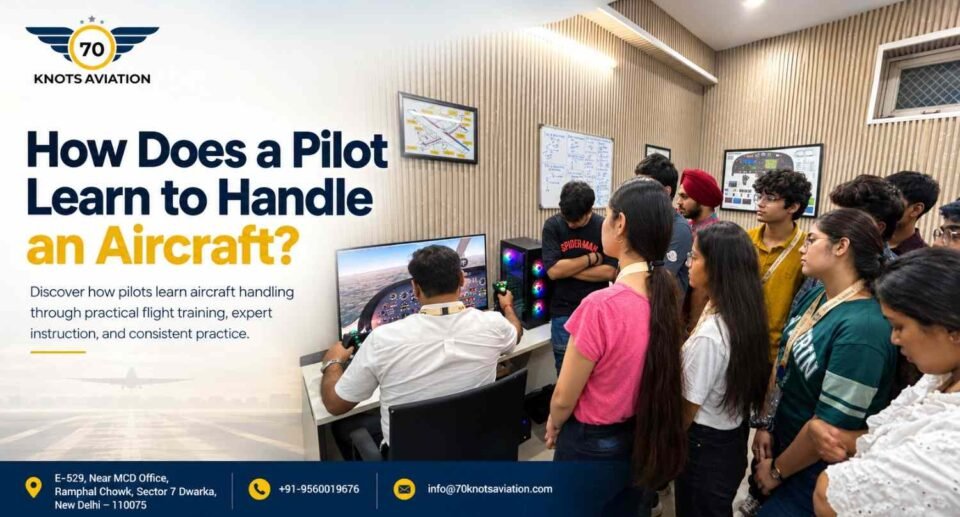
Handling of the aircraft is done gradually through lessons in the class, instructions from the tutor, practicing and finally evaluating the pilot. As such, the student pilot will not walk into the cockpit and start operating on his own. Training in handling aircraft includes first learning about the aircraft and how to handle, maneuver, take off, land and navigate among others.
To those interested in How to become a pilot, this progression is essential. The training is more than just flying. Before handling the aircraft, the student pilot should be able to comprehend theories of aviation, safety, communications and the system of the aircraft. At 70Knots Aviation, this mixture of preparation on the ground and practical lessons makes the student understand what is expected at every phase of pilot training.
What Students Learn Before Flying
A student must first learn about the fundamentals of flight before they can practice handling of the plane. The ground lessons cover such topics as aerodynamics, aircraft systems, meteorology, navigation, aviation regulations, and human factors.
This information will enable students to appreciate the behavior of the aircraft. For instance, the student should be aware of the influence that speed, power, and attitude have on the aircraft before they handle them in flight.
The ground lesson also exposes students to procedures and safety measures. Students learn how to conduct tests and interpret instrument readings and the procedures to observe. This lesson ensures that the students have less uncertainty before stepping into the aircraft.
At 70Knots Aviation, ground preparation lessons can assist students to understand the concepts that they will find in the cockpit during practical training.
How Instructors Introduce Aircraft Controls
In the first few practice lessons, the instructor will normally introduce the trainee to the plane and provide him with an explanation of the functions of its main control mechanisms. These include the control column/stick, rudder pedals, and throttle/power controls.
The students understand that aircraft handling requires coordination of multiple controls as opposed to operating single controls. The instructor shows them how the aircraft reacts to the controls and lets the trainee practice in close monitoring of the instructor.
At this point, the responsibility of creating a safe training environment rests entirely with the instructor. The aircraft handling is gradually introduced to the student as his skills develop.
Learning Basic Aircraft Control
The first important goal here is to build an understanding of how the airplane behaves. Trainees learn how to keep appropriate attitude, heading, altitude and airspeed.
The term “attitude” means the airplane’s position relative to the horizon. “Heading” refers to the direction towards which the airplane’s nose is pointing, whereas “altitude” means the height above a reference point. Finally, “airspeed” shows how fast the airplane moves relative to the air around.
Trainees slowly learn how to control all these parameters simultaneously. They also learn that minor changes are often more helpful than big ones. The teacher demonstrates the right technique and asks the trainee to do the same.
It is quite challenging since newcomers need to learn how to share attention between outside, instruments and control panel.
From Taxiing to Take-Off Preparation
Prior to learning how to take off, students usually become adept at taxiing. In other words, it refers to the movement of the aircraft on the ground using its own power source.
The student is taught how to control direction and speed on taxiing, observing the proper taxiing routes and procedures for the aerodrome. Additionally, they get acquainted with pre-take-off checks and steps needed prior to the runway entry.
The process of take-off demands discipline from students. They need to be aware of the checklist, verify aircraft indications, and communicate properly when necessary.
Once the student has developed sufficient understanding, the instructor introduces take-off handling and continues to supervise the exercise closely.
Maintaining Heading, Altitude and Speed
After takeoff, the students have a lot of time practicing maintaining steady flight. This might seem quite simple, but in reality, it requires a lot of observation and making adjustments constantly.
In case the plane starts deviating from the planned course, the student will learn to notice this and make necessary adjustments. The same applies to changes in altitude and airspeed, where students should be able to figure out why that happened and react properly.
Speed management becomes particularly important because different phases of flight require different speeds. Students learn to coordinate power, attitude and configuration rather than treating airspeed as an isolated number.
The objective is not simply to keep the aircraft pointed in one direction. Students gradually develop the ability to monitor several aspects of flight simultaneously.
Learning Turns, Climbs and Descents
With improvements in basic control, the instructor begins teaching turns, climbs and descents.
During turns, students gain experience in coordinating the controls of the aircraft and proper awareness of altitude, speed and direction. Climbs and descents introduce yet another crucial concept that is how the attitude and power affect the performance of the aircraft.
Students also begin learning how to make smooth transitions from one flight condition to another. For instance, transitioning from straight and level flight into a climb is not an abrupt action but a planned maneuver.
Practical training at 70Knots Aviation can benefit from theoretical knowledge gained through ground preparation.
Communication and Cockpit Awareness
The handling of the aircraft does not occur in a vacuum; in addition to the physical handling of the aircraft, pilots must also be able to communicate well and have situational awareness.
During training, students learn about the use of aviation radio communications and the terms used to communicate with the air traffic services. Air Traffic Control (ATC) offers guidance and instructions to pilots in controlled airspace.
Students also learn situational awareness in that they know what is going on around the aircraft, what has happened before, and what might happen next.
Thus, good cockpit management not only requires the pilot to control the aircraft; the pilot must be able to listen, see, talk, make decisions, and keep flying accurately.
How the CPL Journey Builds Practical Skills
Researching How to become a pilot involves paying attention to qualification and exams, while practical flight training remains an equally essential element of a bigger process. Practical training progresses from simple manoeuvres to complicated ones as the skill level of the trainee grows.
In the case of students interested in acquiring a Commercial Pilot Licence in Delhi, practical training becomes an element of a bigger process of obtaining the CPL. The specifics of training and flying program may differ in each case; hence, it is necessary for the student to know his/her requirements in advance.
In 70Knots Aviation, conversations with the students can make it clear how ground education and practical training work together as elements of the process of becoming a pilot.
Instructor Demonstration and Student Practice
Perhaps one of the most crucial aspects of flight training is the demonstration and practice dynamic. For instance, the instructor can demonstrate the exercise and talk about what they are doing and why.
The student is required to perform the exercise as well while the instructor supervises their performance. In case there is an error in the performance by the student, then the instructor can offer advice, and even take control if necessary.
It is also good to note that a student cannot expect every exercise to be easy right from the start because time is needed to coordinate and judge things.
70Knots Aviation can help students understand that practical learning is built around progressive development rather than expecting instant independence.
From Supervised Flying to Solo Training
Solo flying is an important milestone, but it does not happen simply because a student has completed a particular number of lessons. The instructor must be satisfied that the student has demonstrated the required level of competence and can manage the relevant exercises safely.
Before solo flight, students practice repeatedly under supervision. They need to demonstrate appropriate aircraft control, procedural knowledge, situational awareness and decision-making.
It is also worth mentioning that when students take off on their own, they do not suddenly start learning everything on their own. It means that previous training under supervision has helped them reach such a stage.
Cross-Country and Further Training
In further education of pilots, training becomes more complicated than mere airplane control. In cross-country flying, navigation takes place at larger distances, and additional planning is needed.
It means that trainees become able to make up routes, pay attention to weather, perform various calculations and be aware of their location. They learn how to handle new situations and manage the plane simultaneously.
Further training might include more complicated maneuvers, instrument-related training, emergency training, etc.
Emergency and Abnormal Procedures
Training in flight is designed not only to prepare students to deal with problems that arise as planned, but also with those which arise in an unusual situation.
A pilot may be trained in abnormal and emergency procedures in a controlled training environment. Students will learn how to take actions for various problems that might occur in relation to aircrafts and how to conduct themselves.
Practice will help students know the sequence of actions that must be taken. This training is not intended to instill fear, but just to inform students how pilots deal with unusual problems systematically.
Why Repetition Matters in Flight Training
Handling the aircraft comes more naturally as time passes. A student may be able to comprehend a certain procedure while in class, but he will have to practice enough to be able to perform it well.
Every lesson is an avenue for refining the coordination, observation, and decision making abilities of the student. The instructor observes and determines what areas need more practice.
At 70Knots Aviation, the students can derive from knowing the fact that slow development of one skill does not mean that they are not cut out for flying. Each student develops his own skills differently.
Five Questions Students Often Ask
1. How much time is needed to learn how to handle the plane?
The time differs among students depending on the training course, plane used and the student’s progress level. Basic handling is learnt earlier, but to maintain accuracy consistently, practice is required.
2. Do students fly on their own during training?
Yes, students may be allowed to fly solo as part of their flight training after the instructor has determined their competence and preparedness for such activity.
3. What if the student commits an error while handling the plane?
The instructor monitors the student’s progress and provides necessary corrections to mistakes. The instructor can even takeover the handling of the plane in case need arises.
4. Is aircraft handling hard for beginner students?
It might be difficult since the student needs to coordinate all controls, instruments and external factors simultaneously.
5. How does an instructor know that a student is ready for further training?
Instructors evaluate the level of control, procedure knowledge, consistency, situational awareness and the ability of a student to perform exercises safely. The training continues depending on the student’s competence, not confidence.
A Student – Counsellor Talk
Student: I am afraid that the initial requirement of controlling the aircraft by oneself is too high for beginners. Is this true?
Counsellor: No, it is not. Your training will be progressive. First, your instructor will tell you about the aircraft and demonstrate the controls before performing the exercise.
Student: And what if I do something wrong?
Counsellor: It will be the supervised training where your instructor will conduct the exercise together with you. In case of necessity, he can take the control into his own hands. Mistakes are supposed to be used for learning not the performance on the first try.
Student: And how do students become independent?
Counsellor: This process is also gradual. You learn to control the aircraft, do exercises, procedures and then fly alone when your instructor considers you prepared for that.
Student: So does 70Knots Aviation help students with that?
Counsellor: The important thing is to understand that both ground preparation and practical training contribute to your development. At 70Knots Aviation, students can discuss their training questions and understand what different stages of the learning process involve.
Conclusion
Flying an airplane is a step-by-step process of gaining knowledge, demonstration, guided practice and repetitions. First, a student learns about aviation theory and control of an aircraft, gradually acquiring skills in taxiing, take-offs, straight and level flight, turns, climbs and descents, communication and navigation.
With increasing proficiency, a student progresses towards solo and cross-country flights and learns how to deal with abnormal and emergency situations. The confidence comes along with the practical skills, and not suddenly.
It should be mentioned that the most crucial thing for a beginner pilot is that handling an airplane is a step-by-step process. Using correct instruction, repetitive practice and theoretical background, a student can progressively gain necessary skills for more advanced levels of piloting.
You may also explore this blog for additional information and insights.
https://70knotsaviation.com/blog/why-is-decision-making-important-in-aviation/
The 70Knots Aviation team shares informative and practical insights on pilot training, aviation careers, DGCA requirements, CPL training, flight training, and the Indian aviation industry. Through well-researched articles, the team aims to help aspiring pilots, aviation students, and aviation enthusiasts understand training pathways, eligibility, courses, and career opportunities in aviation. As one of the best pilot training institutes in India, 70Knots Aviation provides clear and useful information to support readers at every stage of their journey toward a career in the skies. With a focus on practical aviation knowledge, the team brings together valuable insights to help readers make informed decisions about their aviation education and career.
1 Comment
[…] Should you wish to undertake CPL training in Mysore, it would be wise for you to conduct your due diligence. You may also find this blog informative :- https://70knotsaviation.com/blog/how-does-a-pilot-learn-to-handle-an-aircraft/ […]