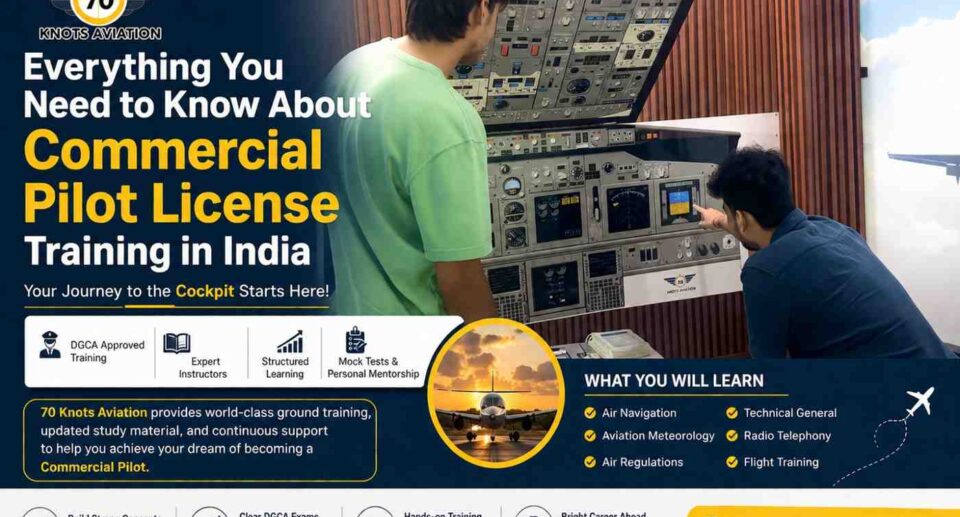
Everything You Need to Know About Commercial Pilot License
The rapid growth of the Indian aviation industry has opened many new career opportunities as a pilot. Indian airlines need as many commercial pilots as they can get due to their growing fleets, the construction of many new airports, and an increasing number of passengers. Commercial pilot training in India is the first step for any student interested in a professional aviation career.
There are many more steps to becoming a commercial pilot, however, aside from actually learning to fly. Aspiring pilots must first develop all of the relevant theory, then pass the DGCA exams and complete flight training before entering the workforce. Throughout this journey, students also develop the professional skills required by the aviation industry. Attending the Best pilot training institute in India is instrumental in achieving long-term success.
At 70 Knots Aviation, students are provided with a variety of tools to help them fully prepare for both DGCA examinations and flight training. These include structured ground training, experienced faculty guidance, updated DGCA study material, and continuous mentorship as part of Commercial pilot license training in India.
CPL (Commercial Pilot License)
The Commercial Pilot License (CPL) is the professional certification that allows pilots to fly aircraft commercially and build a career in aviation. To obtain this license, candidates must complete the training and educational requirements prescribed by the Directorate General of Civil Aviation (DGCA).
Once a pilot earns a CPL, numerous career opportunities become available, including:
- Flying for domestic airlines
- Flying for international airlines
- Operating cargo aircraft
- Flying charter aircraft
- Working in corporate aviation
- Becoming a flight instructor
India’s aviation sector continues to expand rapidly. Factors such as growing airline fleets, increasing domestic and international travel, regional airport development, government investment in aviation infrastructure, expanding cargo operations, and rising demand for qualified pilots have made this one of the best times to pursue Commercial pilot training in India.
Requirements to Pursue Commercial Pilot License Training in India
Students planning to become commercial pilots must meet certain eligibility requirements before beginning their training.
Basic requirements include:
- Completion of Class 12 with Physics and Mathematics
- A valid DGCA-approved medical certificate
- Good communication skills
- Strong analytical ability
- Passion for aviation
Meeting these requirements allows students to begin their aviation journey with confidence.
Commercial Pilot License Training Stages
Ground Training
Ground training is the first and most important stage of aviation education. Students study aviation theory before beginning practical flight training.
Subjects include:
- Air Navigation
- Aviation Meteorology
- Air Regulations
- Technical General
- Radio Telephony
Strong theoretical knowledge improves student performance during every stage of training.
DGCA Examination Preparation
Students must successfully clear the DGCA examinations before progressing further in their training.
Professional coaching, structured classroom sessions, regular revision, and mock examinations significantly improve the chances of success by building conceptual understanding instead of rote memorization.
Flight Training
After completing ground training, students begin practical flying under the supervision of certified instructors.
Flight training includes:
- Basic Flying
- Solo Flying
- Cross-Country Flying
- Instrument Flying
- Night Flying
- Emergency Procedures
- Advanced Flight Exercises
Every flying session improves confidence, technical knowledge, and practical skills.
Skill Assessments and Licensing
After completing the required flying hours and training requirements, students appear for practical skill assessments to obtain their Commercial Pilot License.
Successfully earning the CPL marks the beginning of a professional aviation career.
Subjects Covered During Commercial Pilot License Training
Air Navigation
Air Navigation teaches students how aircraft travel safely between destinations.
Students learn:
- Flight Planning
- Navigation Charts
- Compass Systems
- Radio Navigation
- Flight Routes
- Time-Speed-Distance Calculations
Regular numerical practice improves speed and accuracy.
Aviation Meteorology
Weather knowledge plays a crucial role in aviation safety.
Students study:
- Wind Systems
- Cloud Formation
- Weather Forecasting
- Atmospheric Pressure
- Turbulence
- Visibility
Understanding weather enables pilots to make safe operational decisions.
Air Regulations
Professional pilots must thoroughly understand aviation laws and procedures.
Topics include:
- DGCA Regulations
- ICAO Standards
- Flight Rules
- Aviation Safety
- Air Traffic Procedures
- Pilot Responsibilities
These regulations form the legal foundation of aviation.
Technical General
Technical General explains how aircraft systems function.
Students study:
- Aircraft Engines
- Aerodynamics
- Fuel Systems
- Hydraulic Systems
- Electrical Systems
- Aircraft Performance
Understanding aircraft systems builds confidence before practical flight training.
Radio Telephony
Effective communication is one of the most important responsibilities of every pilot.
Students learn:
- Aviation Phraseology
- Air Traffic Control Communication
- Radio Procedures
- Emergency Communication
Proper communication enhances aviation safety and operational efficiency.
Selecting the Best Pilot Training Institute in India
Choosing the Best pilot training institute in India is one of the most important decisions for aspiring pilots.
A reputed aviation academy should provide:
- Qualified aviation instructors
- Updated DGCA syllabus
- Interactive classroom training
- Regular mock examinations
- Personalized mentoring
- Career guidance
- Professional learning environment
Quality education prepares students for long-term success.
Advantages of Professional Commercial Pilot Training in India
Professional aviation training offers several long-term benefits.
Comprehensive Aviation Knowledge
Students develop a strong understanding of aviation concepts before beginning practical flying.
Better DGCA Examination Performance
Concept-based learning improves understanding and examination results.
Flight Training Readiness
Students begin flight training with greater confidence and preparation.
Strong Decision-Making Skills
Pilots constantly evaluate situations before making operational decisions.
Professional training develops analytical thinking and sound judgment.
Effective Communication Skills
Communication with Air Traffic Control is an essential skill throughout a pilot’s career.
Professional coaching strengthens communication abilities.
Better Career Opportunities
Graduates from reputed aviation institutes often receive better career opportunities across various aviation sectors.
Criteria for Choosing the Best Pilot Training Institute in India
Before selecting an aviation academy, students should evaluate several important factors.
Experienced Faculty
Learning from experienced aviation professionals helps students understand difficult concepts through practical examples.
Updated Study Material
Students should always study according to the latest DGCA syllabus and updated aviation regulations.
Structured Learning
A systematic study plan helps students complete every subject efficiently while reducing examination stress.
Regular Mock Tests
Mock examinations help students improve:
- Accuracy
- Speed
- Time Management
- Confidence
- Examination Strategy
Practicing under real examination conditions significantly improves performance.
Personalized Mentorship
Individual mentoring allows instructors to identify weaker areas and provide customized academic support.
Professional Skills Developed During Pilot Training
Professional pilot training develops valuable life skills beyond aviation knowledge.
Analytical Thinking
Pilots continuously analyze weather conditions, aircraft performance, and operational situations.
Ground training strengthens logical reasoning.
Decision-Making Skills
Professional aviation coaching develops confidence and the ability to make accurate decisions under pressure.
Communication Skills
Pilots must communicate effectively with Air Traffic Control and crew members throughout every flight.
Discipline and Responsibility
Aviation requires professionalism, punctuality, and responsibility.
Ground training develops these qualities from the beginning.
Confidence
Consistent preparation reduces examination stress and builds confidence before both DGCA examinations and flight training.
Career Opportunities After Commercial Pilot License Training in India
Successfully completing Commercial pilot license training in India opens several rewarding career opportunities.
Commercial Airlines
Most pilots begin their careers as First Officers before progressing to Captain positions.
Charter Aviation
Charter pilots operate aircraft for private clients, business executives, and government organizations.
Cargo Aviation
The rapid expansion of logistics and e-commerce continues to increase the demand for cargo pilots.
Corporate Aviation
Corporate pilots operate business aircraft for multinational companies and private organizations.
Flight Instructor
Many commercial pilots begin their careers as flight instructors while building valuable flying experience.
Future of Commercial Aviation in India
India’s aviation industry continues to grow rapidly.
Growth is driven by:
- Expansion of airline fleets
- Increasing passenger traffic
- Development of regional airports
- Growth of cargo operations
- Government investment in aviation
- Rising demand for commercial pilots
These developments continue to create outstanding opportunities for aspiring aviation professionals.
Why Choose 70 Knots Aviation?
Choosing the right aviation academy is one of the most important decisions in becoming a successful commercial pilot.
At 70 Knots Aviation, students benefit from:
- Experienced Aviation Faculty
- Updated DGCA Syllabus
- Interactive Classroom Sessions
- Regular Mock Examinations
- Personalized Mentorship
- Career Guidance
- Student-Centered Learning
- Continuous Academic Support
At 70 Knots Aviation students receive concept-based learning that prepares them not only for DGCA examinations but also for successful flight training and long-term aviation careers.
Tips for Aspiring Commercial Pilots
Students planning to pursue Commercial pilot training in India should follow these important tips:
- Study consistently every day.
- Focus on understanding concepts rather than memorization.
- Practice Air Navigation calculations regularly.
- Revise every subject frequently.
- Attempt mock examinations consistently.
- Stay disciplined and motivated throughout your preparation.
Embarking on Commercial pilot license training in India is an excellent opportunity for students who aspire to become professional pilots. Success in aviation requires quality education, experienced instructors, strong theoretical knowledge, and structured flight training. While selecting the Best pilot training institute in India, students should prioritize educational quality, professional mentorship, updated DGCA preparation, and career guidance rather than focusing only on training costs.
With experienced faculty, concept-based learning, personalized mentorship, and continuous academic support, 70 Knots Aviation provides aspiring pilots with the professional knowledge, confidence, and practical skills required to excel in Commercial pilot training in India and build a successful career in the rapidly growing aviation industry.
FAQ
1. What is the eligibility for Commercial Pilot License training in India?
To begin Commercial Pilot License training in India, candidates must have completed Class 12 with Physics and Mathematics, hold a valid DGCA Class 1 or Class 2 Medical Certificate, and meet the eligibility requirements prescribed by the DGCA.
2. How long does Commercial Pilot training in India take?
The duration of Commercial pilot training in India generally ranges from 18 to 24 months, depending on the student’s progress, weather conditions, flying hours, and DGCA examination schedule.
3. How do I choose the best pilot training institute in India?
When selecting the Best pilot training institute in India, look for experienced instructors, updated DGCA-approved study material, structured ground classes, modern training facilities, regular mock tests, and strong placement or career guidance support.
4. What subjects are covered during Commercial Pilot License training in India?
Commercial Pilot License training in India covers important aviation subjects such as Air Navigation, Aviation Meteorology, Air Regulations, Technical General, Radio Telephony (RTR), and practical flight training as per DGCA guidelines.
5. What career opportunities are available after completing Commercial Pilot License training in India?
After completing Commercial Pilot License training in India, pilots can build careers with domestic and international airlines, cargo airlines, charter operators, corporate aviation companies, or work as certified flight instructors.
6. Why is DGCA ground training important before flight training?
DGCA ground training provides the theoretical knowledge required to understand aviation principles, aircraft systems, navigation, weather, and aviation regulations. A strong foundation helps students perform better in DGCA examinations and practical flight training, increasing their chances of becoming successful commercial pilots.
7. Why should I choose 70 Knots Aviation for Commercial Pilot License training in India?
70 Knots Aviation offers experienced aviation instructors, updated DGCA study material, structured classroom training, regular mock tests, personalized mentorship, and continuous career guidance. Its concept-based learning approach helps students confidently clear DGCA examinations and build a strong foundation for a successful career as a commercial pilot.
The 70Knots Aviation team shares informative and practical insights on pilot training, aviation careers, DGCA requirements, CPL training, flight training, and the Indian aviation industry. Through well-researched articles, the team aims to help aspiring pilots, aviation students, and aviation enthusiasts understand training pathways, eligibility, courses, and career opportunities in aviation. As one of the best pilot training institutes in India, 70Knots Aviation provides clear and useful information to support readers at every stage of their journey toward a career in the skies. With a focus on practical aviation knowledge, the team brings together valuable insights to help readers make informed decisions about their aviation education and career.