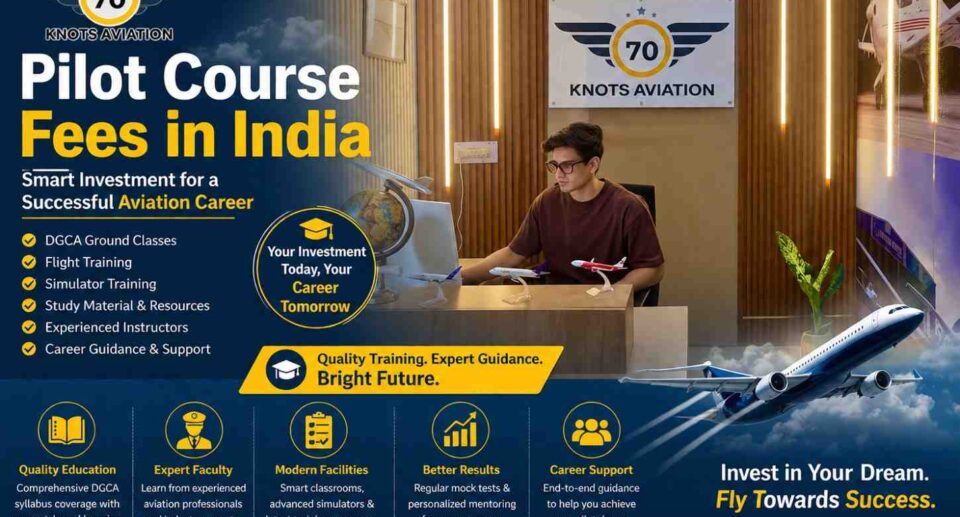
Pilot Course Fees in India: Smart Investment for a Aviation Career
Becoming a commercial pilot is a promising career path for students. India’s aviation industry is rapidly growing. The expansion of several airlines, development of new airports, and the consistent increase in passenger traffic is creating a greater need for commercial pilots. Despite these facts, many students wanting to embark on the commercial pilot path usually have one important question before they do: what are the pilot course fees in India?
As part of your aviation career planning, you need to have an understanding of the pilot training fees in India. While the cost is an important factor, you should think about the training quality, the instructors, the training facilities, and the career development services. The benefits of investing in professional aviation training are career-long.
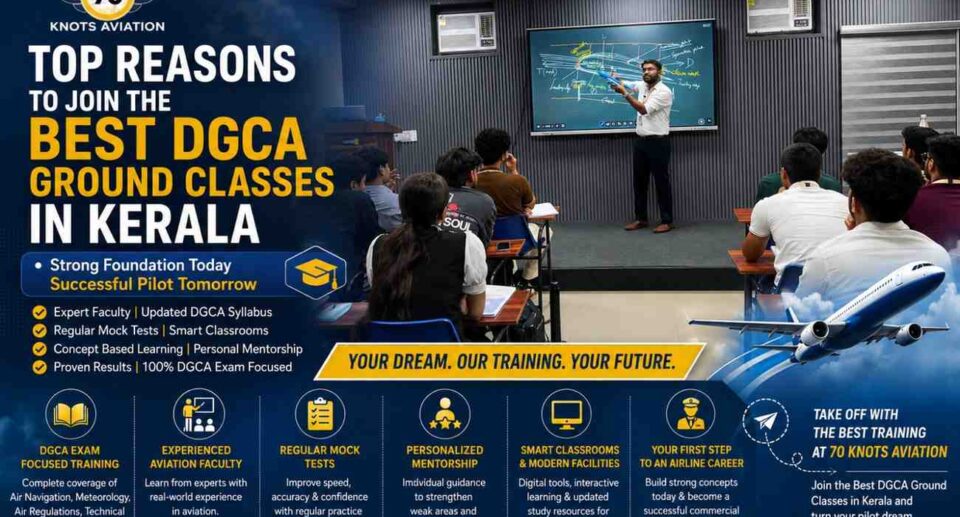
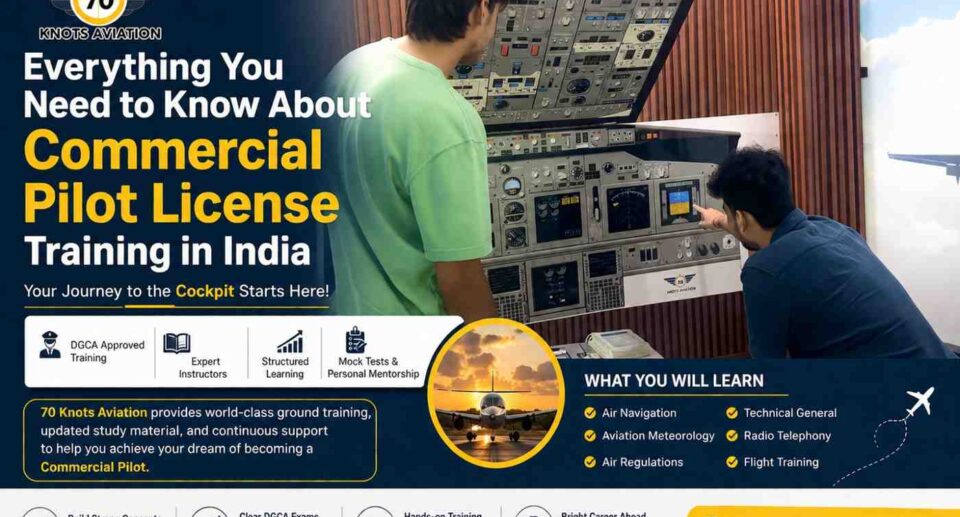
At 70 Knots Aviation, aspiring pilots are provided structured ground training with improved mentorship, updated DGCA study materials, and continued academic support.
Pilot Training as an Investment
Aviation training is a special combination of training and education that incorporates both the theoretical and practical branches of the profession, as opposed to many other careers, which primarily have a theoretical component. It is a significant financial and time commitment.
There are multiple benefits of selecting a top-notch aviation institute:
- Strong Theoretical Foundation
- Professional Flight Readiness
- Better Exam Results
- Enhanced Technical Skills
- Career-Oriented Counseling
- Increased Confidence Prior to Flight Training
Instead of regarding aviation training as a cost, it’s wise to consider it as an investment for a fruitful and honorable career.
Pilot Course Fees in India
Among future pilots, pilot course fees in India is one of the top queries. The total cost usually depends on multiple significant factors rather than a single fixed number.
Some of the crucial components are:
- DGCA Ground Classes
- Flight Training
- Simulator Training
- Study Material
- Medical Examination
- Licensing
- Instructor Experience
- Infrastructure & Facilities
Different aviation institutes have different fee systems based on the caliber of education and training.
Instead of selecting an institute based on the lowest fees, it is advisable to consider the quality of training, success rate, faculty, and student support.
Components of Pilot Training Costs in India
The pilot training cost in India differs as every aviation academy has a different learning environment and different facilities.
Quality of Ground Training
Ground training is the first and most important component of pilot training. It is imperative for students to have clear concepts of aviation prior to undertaking flight training.
Some of the aspects professional ground schools offer are:
- Aviation Instructors of Distinction
- Updated DGCA Syllabus
- Interactive Classrooms
- Learning and Teaching Exercises
- Regular Assessments
- Personalized Mentoring
Individuals who receive superior preparation during ground school frequently exhibit a higher success rate in DGCA examinations.
Flight Training Cost in India
Flight training is one of the most essential factors that influence the pilot training cost in India.
Flight training incorporates:
- Basic Flying
- Solo Flights
- Cross-Country Navigation
- Instrument Flying
- Emergency Procedures
- Night Flying
The overall cost includes the training standards, the experience of instructors, and the quality of the aircraft.
Simulator Training
Modern aviation training includes the use of flight simulators. Flight simulators allow students to practice numerous flying scenarios in a safe and controlled setting.
Simulator training allows students to enhance:
- Decision-Making
- Aircraft Handling
- Flight Procedures
- Emergency Response
- Safety and Confidence
Importance of DGCA Ground Training
Students need to gain an adequate understanding of aviation theory before practical flying commences.
Ground training builds an understanding of the following aviation subjects.
Air Navigation
Students learn:
- Flight Planning
- Navigation Charts
- Compass Systems
- Radio Navigation
- Time-Speed-Distance Calculations
Constant practice helps students improve their numerical skills and develop the ability to solve complicated problems.
Aviation Meteorology
Students learn the effects of weather on flight, including:
- Wind Systems
- Clouds
- Atmospheric Pressure
- Weather Forecasting
- Turbulence
- Visibility
This knowledge helps students make well-informed operational decisions as pilots.
Air Regulations
Students learn the duties and responsibilities of pilots regarding aviation safety and air traffic regulations.
Regular revision helps students retain aviation rules and procedures.
Technical General
Students learn the functioning of:
- Aircraft Engines
- Aerodynamics
- Hydraulic Systems
- Fuel Systems
- Electrical Systems
This knowledge builds confidence before practical flight training.
Radio Telephony
Effective communication is one of the most important skills every pilot must master.
Students learn:
- Standard Aviation Phraseology
- Air Traffic Control Communication
- Radio Procedures
- Emergency Communication
Strong communication skills increase operational safety.
Selecting the Appropriate Aviation Institute
While comparing pilot course fees, students should evaluate several important considerations and not just the fee.
Experienced Faculty
Experienced aviation professionals make difficult concepts easier to understand through practical teaching methods and real-world examples.
Updated Study Materials
Aviation regulations are revised regularly.
Institutes that continuously update their learning resources according to the latest DGCA syllabus provide students with better preparation.
Structured Learning
Students perform better when subjects are taught in a planned and systematic manner.
Organized learning ensures consistent preparation.
Regular Mock Examinations
Mock examinations help students improve:
- Time Management
- Confidence
- Accuracy
- Problem-Solving Skills
- Examination Strategy
Personalized Support
Every student has different learning needs.
One-to-one mentoring enables instructors to identify weaknesses and provide customized guidance.
Why Quality Training Should Be Preferred Over Low Fees
Education and aviation training should never be chosen solely because of lower fees.
Quality training provides:
- Better Conceptual Understanding
- Higher Examination Success
- Professional Confidence
- Better Career Opportunities
Students also benefit from structured teaching methods that help them complete training efficiently without unnecessary delays.
Skills Acquired Through Professional Pilot Training
Professional pilot training develops many skills beyond flying an aircraft.
Analytical Thinking
Pilots continuously assess weather, aircraft performance, and operational situations.
Ground training strengthens logical thinking and analytical abilities.
Decision-Making Skills
Quick and accurate decision-making is essential during every flight.
Professional coaching develops sound judgment under pressure.
Communication Skills
Pilots must communicate effectively with Air Traffic Control and cabin crew members.
Discipline
Aviation requires responsibility, punctuality, and professionalism.
Ground training develops these qualities from the beginning.
Confidence
Systematic preparation builds confidence for DGCA examinations and practical flight training.
Avoidable Mistakes That Students Make
Many aspiring pilots delay their success because of avoidable mistakes.
Common mistakes include:
- Late Preparation
- Ignoring Difficult Subjects
- Skipping Revision
- Relying on Memorization
- Avoiding Mock Tests
- Poor Time Management
- Lack of Consistency
Avoiding these mistakes significantly improves examination performance.
Career Opportunities After Pilot Training
Professional pilot training opens numerous career opportunities.
Commercial Pilot
Most students begin as First Officers before progressing to Captain positions.
Charter Aviation
Charter pilots operate aircraft for private clients, business executives, and government organizations.
Cargo Aviation
The growth of logistics and e-commerce has increased the demand for cargo pilots across India.
Corporate Aviation
Corporate pilots fly business aircraft for companies and private organizations.
Flight Instructor
Many pilots begin their careers as flight instructors while building valuable flying experience.
Each of these career options offers excellent salary growth, international opportunities, and long-term career development.
Future of Aviation in India
India’s aviation sector continues to grow rapidly.
This growth is driven by:
- Expansion of Airline Fleets
- Growth in Domestic Air Travel
- Development of Regional Airports
- Rising Passenger Traffic
- Expansion of Cargo Aviation
- Increased Demand for Commercial Pilots
These developments continue to create outstanding employment opportunities for aviation professionals.
Students who begin their aviation journey today are entering one of India’s fastest-growing industries.
Why Choose 70 Knots Aviation?
Choosing the right aviation academy is one of the most important decisions in becoming a commercial pilot.
At 70 Knots Aviation, experienced instructors provide quality education through structured classroom learning, updated DGCA study materials, regular mock examinations, and personalized mentoring.
Students benefit from:
- Updated DGCA Requirements
- Interactive Classroom Sessions
- Regular Mock Examinations
- Personalized Mentoring
- Career Guidance
- Concept-Based Learning
- Continuous Academic Support
The institute emphasizes conceptual learning rather than rote memorization, helping students perform better in DGCA examinations and practical flight training.
Whether you are beginning your aviation journey or strengthening your theoretical knowledge, 70 Knots Aviation provides the professional guidance required to build a successful aviation career.
Smart Tips Before Investing in Pilot Training
Before investing in pilot training, students should:
- Review the quality of training offered.
- Choose experienced instructors.
- Ensure the DGCA study material is updated.
- Select institutes that conduct regular mock examinations.
- Look for personalized mentoring.
- Evaluate classroom infrastructure and the learning environment.
- Focus on long-term career goals rather than short-term savings.
Making informed decisions today can significantly improve future career opportunities.
Every aspiring commercial pilot should understand pilot course fees in India before beginning their aviation journey. Although pilot training fees in India and the overall pilot training cost in India vary depending on the institute, facilities, and quality of education, professional training should always be prioritized over lower-cost alternatives.
A successful aviation career is built on a strong theoretical foundation, experienced instructors, structured learning, continuous evaluation, and personalized guidance. Investing in quality education improves performance in DGCA examinations, strengthens practical flight training, and creates better long-term career opportunities.
With experienced faculty, updated learning resources, structured classroom training, and a student-focused approach, 70 Knots Aviation continues to help aspiring pilots develop the knowledge, confidence, and professional skills needed to build a successful and rewarding career in aviation.
FAQ
1. What are the average pilot course fees in India?
Pilot course fees in India vary depending on the aviation institute, training facilities, aircraft, and flight hours. Students should compare the quality of training along with the overall investment before enrolling.
2. What factors affect pilot training fees in India?
Pilot training fees in India depend on DGCA ground classes, flight training hours, simulator sessions, instructor experience, study materials, licensing, and infrastructure provided by the institute.
3. What is included in the pilot training cost in India?
The pilot training cost in India generally includes DGCA ground training, flying hours, simulator training, medical examinations, study materials, licensing support, and practical flight instruction.
4. Why should I compare pilot course fees before choosing an aviation institute?
Comparing pilot course fees helps you understand the value offered by different institutes. Always choose an academy that provides experienced instructors, updated DGCA training, mock tests, and career guidance.
5. Is investing in a pilot course in India worth it?
Yes. With India’s rapidly growing aviation industry and increasing demand for commercial pilots, investing in quality pilot training can lead to excellent long-term career opportunities.
6. Why choose 70 Knots Aviation for pilot training?
70 Knots Aviation offers expert DGCA ground training, experienced faculty, updated study materials, structured classroom learning, regular mock tests, and personalized mentoring to help aspiring pilots build a successful aviation career.
The 70Knots Aviation team shares informative and practical insights on pilot training, aviation careers, DGCA requirements, CPL training, flight training, and the Indian aviation industry. Through well-researched articles, the team aims to help aspiring pilots, aviation students, and aviation enthusiasts understand training pathways, eligibility, courses, and career opportunities in aviation. As one of the best pilot training institutes in India, 70Knots Aviation provides clear and useful information to support readers at every stage of their journey toward a career in the skies. With a focus on practical aviation knowledge, the team brings together valuable insights to help readers make informed decisions about their aviation education and career.