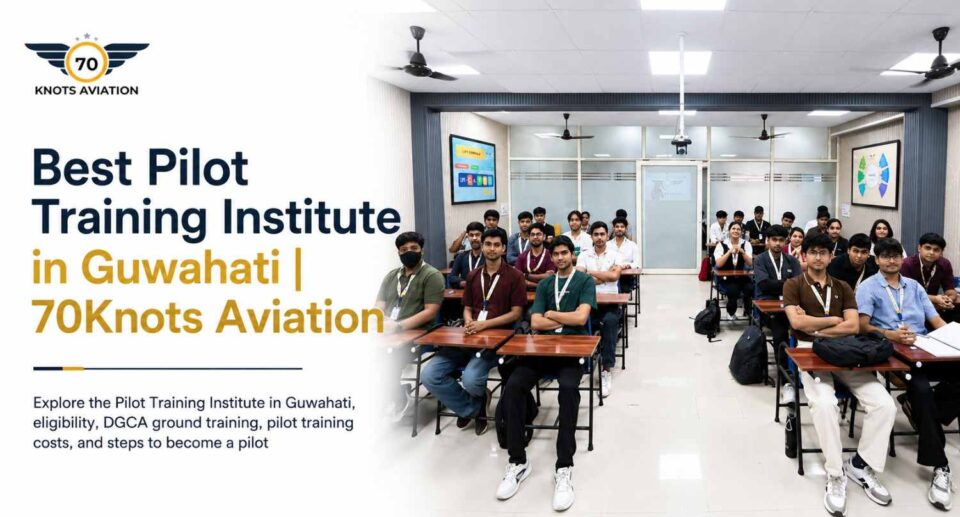
Best Pilot Training Institute in Guwahati
A Comprehensive Guide to Pursuing a Career in Aviation
Becoming a pilot isn’t just about a love for airplanes. A future pilot should be prepared academically, medically, and technically, while also possessing self-discipline, flying skills, an understanding of aviation rules, and an understanding of the multiple stages of the process. From the Professional Aviation Training Standards, students from Assam and beyond Northeast settle on Guwahati as their first centre for aviation training, as well as the first centre for their professional careers.
Those looking for a Pilot Training Institute in Guwahati should, in addition to the academic training, understand how the processes of becoming a pilot flow and merge. Ground training, DGCA examinations, medical examinations, flying training, licensing, and preparation for the airlines are all part of the process, but are also distinct stages.
This article aims to provide the answers to all the questions a student planning to fly under the wing of a Pilot Training Institute in Guwahati may have. It provides a step-by-step explanation of the processes involved, including eligibility, DGCA subjects, the selection process and training, finances, and common blunders, as well as the role of 70Knots Aviation in the preparation of aspiring pilots for their aviation examinations.
Pilot Training in Guwahati
Guwahati is one of the most important aviation centers in the Northeast of India and connects the region with the rest of the country. This makes it an ideal career path for students from Assam and the surrounding states.
While it may be tempting to think of training to become a pilot as a single classroom course, training to become a professional pilot is a long and arduous process, and a student will only fulfill their dream of training to become a professional pilot once they have completed and cleared all stages of the process.
The first step is to learn about the eligibility and medical requirements. Students then must prepare for the DGCA examinations by undergoing structured ground training. Once they complete the theoretical and regulatory stages, flight trainees progress to practical flight training through the selected Flight Training Organisation.
It is essential to understand this process when considering Pilot Training Institutes in Guwahati. While some institutes may offer ground training and exam preparation, it is common for practical flying to be conducted through a Flight Training Organisation.
Aviation as a Career
An aviation profession provides a blend of technical, organizational, and interpersonal skills. The degree of responsibility is at the command level and extends to the operational level of the flight and the flight management process, as well as decision-making in a safety context.
For students who have an inclination towards mathematics, physics, technology, and traveling, along with a practical bent of mind, aviation is a great career choice. However, it should be understood that aviation, and especially piloting, is a challenging profession and requires a great deal of hard work.
The lure of this profession should not be the main deciding factor, and a student must be ready to undergo several examinations, a long flight of preparatory work, and the need to continue self-training for a career’s duration.
Students from Guwahati should proceed with their ground training and DGCA pathway research on their own. Having decided on where to do their ground training, students should proceed with research regarding practical flight training to complete their journey.
Eligibility Requirements for Becoming a Commercial Pilot
Before applying for a pilot training program, you must determine if you fulfill the requirements.
In India, for the commercial pilot pathway, it is common to have Physics and Mathematics at the higher secondary or senior secondary level. Candidates who have not studied these subjects should look for other recognized equivalent-level alternatives and check the latest requirements before commencing the training.
There are minimum age requirements that students have to keep in mind while preparing their aviation study programs, but students can make preparations for becoming a pilot even before they become eligible by age. There is a need of English proficiency in students as English phrases are used in aviation communication, and most of the technical literature and examination papers are also written in English. The health of a pilot also matters, so he should do his aviation medical examination at an early stage.
How to Become a Pilot in Guwahati
There are several stages and processes involved in the journey to become a pilot in Guwahati.
The first stage involves meeting the necessary educational and medical requirements. Once these requirements meet DGCA requirements, candidates must undertake the required processes and preparations for the required exams.
The next stage is ground training. Students are taught about aviation meteorology, air navigation, air regulations, and many other technical and non-technical subjects which are core to professional aviation.
After passing all examinations, students are eligible for practical flight training. Training should be undertaken with an authorised flight training organization.
The practical aspect of training focuses on developing competency in the handling of aircraft, take-offs and landings, and the planning and execution of flights in regard to navigation and communication. It also involves the learning of emergency and other complex flying situations.
Following the completion of the required flying, examinations, checks, and documentation, candidates can commence the process for the relevant licensing.
Obtaining a flying license is just one of the many steps for an aspiring pilot. Further studies to prepare for career opportunities in the aviation industry, training for additional licenses, and meeting the requirements of a particular aircraft and the recruitment process of an airline are all part of the continuing commitment of a career pilot.
The Importance of Ground Training
Ground training forms an essential part of the training for a commercial pilot license. Ground training develops the student pilot’s knowledge of the theory and principles of different aspects of flying, including the technology of navigation, meteorology, regulations, operating procedures, communications, and aircraft systems.
As an example, the Air Navigation training course provides the student with knowledge of position, direction, distance, time, and the planning of a route, all of which are fundamental to flight operations.
Aviation Meteorology focuses on the weather and its impact on air operations. An understanding of weather phenomena including flight obscurants, icing, and thunderstorms is essential for the student pilot to be able to interpret a weather report.
Through Air Regulations and the other technical subjects, the student learns the principles of the systems and equipment of the aircraft.
Radio communication is important. While interacting with air traffic control and other personnel, pilots must communicate in a clear and standardized way.
Ground training cannot be restricted to just passing exams. It must include the professional foundation of the students.
Choosing the Right Pilot Training Institute
While selecting a Pilot Training Institute in Guwahati, research beyond comparing course prices is necessary.
The curriculum, faculty experience and background, teaching methodology and style, study material, and exam preparation, as well as test series and answer keys for all doubt-clearing sessions, must be of a sufficiently high standard to assist students in understanding difficult aviation concepts and reduce the reliance on memorization.
The students need help in specific subjects, particularly in case of calculation, rules, navigation ideas, and theories. The training organization should make it clear what is included in the price and what other cost exists apart from that. The students should be able to differentiate between ground school and flight training programs.
How 70Knots Aviation Supports Pilot Preparation
70Knots Aviation focuses on aviation ground training and preparation for DGCA examinations. It employs a training methodology for theoretical preparation that is important for commercial pilots.
The academy’s training covers many aviation topics such as Air Navigation, Aviation Meteorology, Air Regulations, and Radio Telephony Restricted, among others. It has a series of programs targeted at helping students understand the concepts and prepare for exams in a stepwise manner.
If prospective pilots from Guwahati are considering ground-based training, 70Knots Aviation may be one of the training providers they should look into. The academy’s website has detailed information about the training programs and the support given to students.
It is important to understand that ground training and flight training are distinct from each other. Students should also research and select an appropriate training provider for the flying component, or practical training, of their professional pilot training.
A student who understands ground training and flight training is able to plan training, budget, and organize the required documentation, examinations, and flying.
From Ground Training to Flight Training
While ground training focuses on theory, flight training requires practical flying experience.
When it comes to the process of flight training, the instructor is responsible for equipping the students with all the necessary information regarding flying such as aircraft operation, skills involved in flights, navigation around airports and air traffic, communications, safety measures, procedures in case of emergencies, takeoffs and landings, and different aircraft maneuvers.
The availability of flight training can also affect a student’s experience. The serviceability of aircraft, instructor availability, the airport’s scheduled operations, and the weather can affect the student’s training.
Before a student commits to a significant financial outlay, they should conduct a thorough examination of Flight Training Organisations.
It is also important to inquire about airport and flight training time, scheduling flexibility, options for maintenance support, overnights, and the potential for extra costs and delays.
Potential students should also check the current status of the organization as well as what DGCA regulations apply to them.
Pilot Training Costs
Students always wonder about the amount of money required for a training program, but there is no exact answer to this question since costs differ for individuals. The ground school constitutes just one aspect of the total costs. There may be other things that students have to pay for like flight school, medical tests, DGCA tests, lodging, travel, study materials, licenses, and other flying costs.
The flying process may increase the total costs. Availability of flights, the weather condition, and other aspects related to flying may influence the total cost. Students should demand an estimation of all these costs before joining the program.
How Long Does It Take to Train to Be a Pilot?
Every student will have a unique timeline for completion of his or her pilot training program.
There are many things that can influence a student’s training such as examination dates, availability at the flight schools, medical clearance, academics, staffing issues, weather, scheduling, paperwork and many other things. Flight schools may plan their training programs depending on the academic schedule of the student but the actual training and licensing process may take longer time.
It is also necessary for students to know the training program and any challenges that might delay their training process.
Students can make a quick progress in their licensing process by adopting a systematic approach and passing all the required exams.
Career Opportunities After Pilot Training
Once you clear the required licensing pathway along with the employer requirements, then you have the opportunity to work in several areas of the aviation industry.
Though working with airlines is the most popular choice, there are several other areas in aviation one can work in. These include:
- Charter aviation
- Corporate aviation
- Cargo aviation
- General aviation
- Flight instruction
- Other specialized aviation roles
For most people, their first job as a pilot with an airline is just the start of their career. They continue the journey by developing more experience, learning more about different aircraft, and continuously maintaining their qualifications.
It is important to remember that, even after obtaining your pilot license, working as a pilot with an airline is not guaranteed. Hiring depends on current conditions in the industry, plus your qualifications, experience, fitness, interview, training, and how you present yourself overall.
This is the reason you should look at education in aviation as just one part of your journey to becoming a pilot. The focus should really be developing skills.
Common Mistakes to Avoid When Becoming a Pilot
Most aspiring pilots choose their flight school based on the cheapest advertising. This is often a poor choice. There are many factors that will impact training and each is as important as the other. Transparency, support, quality instruction, and availability of planes are all major factors that affect training.
There are also trainees that wait too long to take the medical assessment. All that work to prepare can go to waste if you can’t take the training. It is better to do it early on so that you are not taking a chance.
There is also the mistake of purely memorizing answers. Aviation is a practical subject that requires a depth of understanding because you will have to apply that knowledge to many operational scenarios.
Prospective pilots also do not research the flight schools they are interested in joining enough. Before joining a school, you should research their training, availability of training planes, support, costs, and the regulations they follow.
The most important advice is not to rely on outdated information. DGCA procedures and regulations can vary, and it is your responsibility to check what current procedures are.
Aviation Career Advice
Remember that embarking on a career as a pilot is not the end of education; it’s the start of your professional journey. You will have to remember things, understand the processes, and stay safe and sound. A dynamic and constantly changing industry awaits your attention for the entirety of your career. The key is to start some of these habits in ground school so that you can apply them in a few years’ time when you are flying.
Ground school is a great place to form the studying habits you will need to learn all the aviation concepts.
Developing communication skills is a lifelong process that helps in many aspects of life. This includes classroom instruction, flight operations, cockpit environments, and interviews.
Those aspiring to become pilots in Guwahati must first comprehend the entire process and know how complicated a career in aviation is. When the process is broken down and each step is planned correctly, the student will be able to prepare himself academically, medically, and financially.
Frequently Asked Questions
1. How can I become a pilot in Guwahati?
There are many steps which include meeting the educational and medical criteria, completion of DGCA-related documents and examinations, undergoing ground training, undertaking the required practical flight training with an FTO, and meeting the licensing requirements.
2. What qualifications are required to become a commercial pilot in India?
This usually includes a certain level of education, which includes Physics and Mathematics, along with meeting the age, medical, examination, training, and licensing requirements. DGCA requirements should be verified before starting any such training.
3. Is Physics and Mathematics compulsory for pilot training?
Sure, the students opting for commercial pilot route in India need to take Physics and Mathematics as well. In case if the students have some other options available, then they should check out those options properly before starting the pilot course.
4. How important is the DGCA medical examination?
The aviation medical examination is crucial for determining the medical fitness required for a career in professional flying. The assessment can be undertaken early so that the student knows about the requirement before making a significant financial investment in the training.
5. What subjects are included in DGCA ground classes?
DGCA ground schools usually consist of courses such as air navigation, meteorology, air regulations, technical general, technical specific, and radio telephony restricted. The tutors assist the students to learn about these topics and prepare them for the necessary exams. However, it is important for the students to refer to the current DGCA guidelines for examination topics.
6. Does 70Knots Aviation offer pilot ground training?
70Knots Aviation does offer pilot ground training and helps students prepare for the DGCA examinations. Students should contact the academy directly for current course details and availability.
Conclusion
There are many aspects that potential students need to consider when opting to study aviation in Guwahati. To begin with, there are multiple aspects and steps that will lead you from zero to becoming a professional pilot. The steps include, but are not limited to, eligibility, DGCA requirements, medical assessments, training, flying, and licensing.
Being aware of the steps and processes required to become a pilot in Guwahati will assist students in making informed decisions regarding the selection of a learning institution, preparation for examinations, selection of a flight-training organization, and planning their finances.
For this process, students need to ensure that they have fully researched the regulatory and licensing requirements for training.
70Knots Aviation will assist you in part of this journey by offering ground training and DGCA preparation.
With sufficient planning and realistic expectations, potential students from Guwahati and all of Northeast India can further their dream of having a professional career in aviation.
The 70Knots Aviation team shares informative and practical insights on pilot training, aviation careers, DGCA requirements, CPL training, flight training, and the Indian aviation industry. Through well-researched articles, the team aims to help aspiring pilots, aviation students, and aviation enthusiasts understand training pathways, eligibility, courses, and career opportunities in aviation. As one of the best pilot training institutes in India, 70Knots Aviation provides clear and useful information to support readers at every stage of their journey toward a career in the skies. With a focus on practical aviation knowledge, the team brings together valuable insights to help readers make informed decisions about their aviation education and career.