Best CPL DGCA Ground Classes in Pune

Becoming a commercial pilot involves much more than having a passion for flying. In order to take control of an aircraft, prospective pilots must have adequate knowledge about the theory of aviation, navigation, meteorology, regulations, and aircraft system. Theoretical knowledge forms a critical component of the journey to get a Commercial Pilot Licence (CPL).
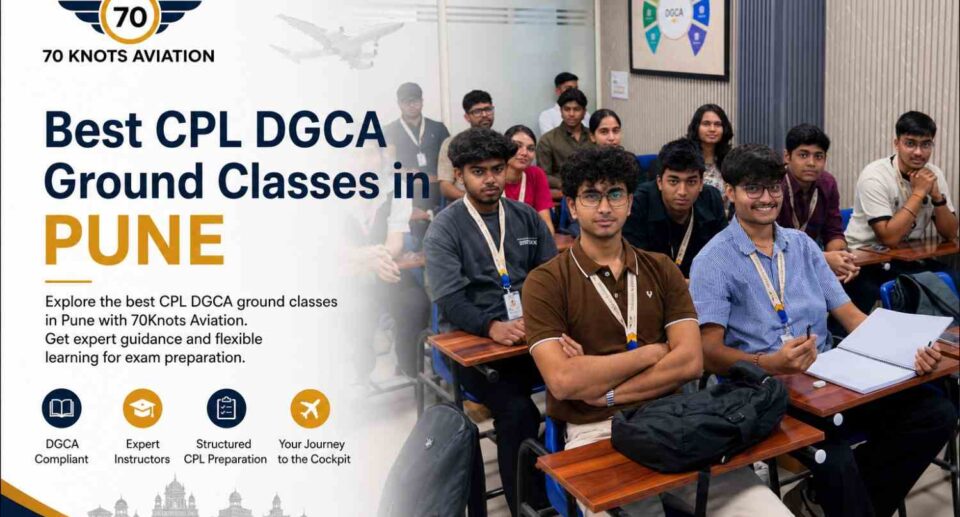
Those who are planning on taking CPL DGCA ground classes in Pune can choose an effective setting that will make it easier to prepare for their examinations. Whether you are just starting out in aviation or getting ready for your final DGCA examinations, effective ground preparation can be very useful for you.
Ground Training Provided By 70Knots Aviation Emphasises Student Understanding of Aviation Concepts, Systematic Preparation And More Confidence To Sit For Their DGCA Exams.
Why Choose Pune for Aviation Study
It is common knowledge that Pune is an education hub and has many students studying here not only from different parts of Maharashtra but also from other places. The presence of a student population and availability of resources makes it a convenient choice for students to undergo their specialisation training.
Students studying at Pimpri-Chinchwad, Hinjawadi, Kothrud, Baner, Wakad, Hadapsar, Nigdi, Talegaon, Chakan, Satara, Kolhapur, Ahmednagar, Nashik, Solapur and other areas may look into aviation study at Pune.
Not only due to convenience, but students have the availability of libraries, studying facilities, hostels and others, which make it convenient for them to have a consistent study schedule. Being amidst other students will also make it possible for students to exchange thoughts and motivate themselves in their preparation period.
DGCA Ground Training – What Is It?
Ground training provides the theoretical basis for the training of professional pilots. Flight experience is necessary, but pilots require understanding the theory behind their operations, weather, navigation, aircraft systems, and aviation laws.
Depending on the type of license and relevant DGCA requirements, the topics covered during ground training may include the following:
- Air Navigation
- Aviation Meteorology
- Air Regulations
- Technical General
- Technical Specific, where applicable
- Radio Telephony and communication requirements
These topics are not fully independent from each other. Navigation requires calculations and planning, while meteorology may affect the flight planning directly. Air Regulations give the legal basis of operation of flights, while technical topics allow the student to get acquainted with the aircraft he or she is going to fly.
Choosing a CPL Coaching Centre in Pune, a student, therefore, should pay attention not only to the number of exercises but to the way these exercises help the student understand the topic better.
How Ground Training Helps Students Become Efficient
Acquiring Basic Information about Aviation
For aspiring pilots, it is necessary to get acquainted with the terms used in aviation, the principles of flight, and the rules. This information can be acquired systematically in a course rather than in bulk.
Connections between the Subjects
The knowledge about aviation becomes practical once the connections between the subjects are made. Thus, information about the weather is applicable to navigation and flight planning, while the aircraft performance is based on the technical knowledge and operations.
DGCA Exams Preparation
Concepts should be studied along with exercises, revision, and mock exams which will help in finding the weak spots, managing time and understanding the types of questions.
Characteristics of a Good CPL Ground Training Academy
When selecting an aviation school, it is better not to compare the courses advertised in brochures only. It is important to pay attention to the teaching method, faculty, study materials, and the whole studying process.
Experienced Instructors
Difficult concepts related to aviation might become easier to comprehend if taught using real-world examples. Students need the chance to ask questions and clear any doubts instead of sticking to the notes only.
Conceptual Training
Memorization of answers might be effective for short-term studying but will not be very helpful during pilot training in the long run. Students need to know the reasons behind the answers.
Learning Flexibilities
Some students might be busy with completion of graduation, flight training, and other such activities along with their ground preparations. Flexible scheduling will assist in ensuring continuity without any disruption in other parts of their training process.
Study Materials Update
Requirements for aviation training and examinations can differ. Therefore, it is essential that students should confirm whether the academy updates its study materials accordingly with respect to the DGCA requirements.
Doubt-Clearing Support
Questions are a natural part of learning aviation. A useful training environment should allow students to raise doubts during or after classes and receive clear explanations rather than leaving difficult concepts unresolved.
Common Difficulties Faced During DGCA Exam Preparation
Students start off very enthusiastically but find it difficult to retain that level of consistency for several months to come. Knowing about common difficulties that arise during preparation will assist students in adopting better habits.
Dependence on Rote Learning
Past questions and exam papers provide good preparation resources but should be used as supplementary to concept-based learning. Students who have knowledge about the concept underlying the question are well-prepared even when the language or context changes.
Postponing Air Navigation to the Last Minute
The subject of air navigation involves frequent calculations. It is recommended that students do not postpone the preparation of this topic till the last minute. Consistent and periodic practice sessions will make them comfortable with calculations.
Ignoring Hard Topics
It is natural that students pick topics in which they are comfortable. Nevertheless, sticking to only those topics which are easy might result in poor preparation levels. The ideal study schedule involves an equal amount of time spent on both hard and easy topics.
Irregular Revisiting
Mastery of the topic is not sufficient to remember the information. Revision ensures that students go back to key ideas and pinpoint those topics which need extra effort before the exam period.
How to Plan an Effective DGCA Study Program
There is no one-size-fits-all study duration. It all depends on the quality of preparations.
An effective daily schedule may include:
- Acquiring knowledge on a new concept or topic
- Revising the material already covered
- Practicing questions
- Analyzing wrong answers
- Keeping notes
- Reviewing difficult topics periodically
In addition to that, students may break down larger subjects into smaller topics. It will make it easy to monitor their progress and will prevent them from getting burdened.
Preparation Subject-Wise for DGCA Examinations
There is a unique way to prepare for each aviation subject. The students who attend CPL DGCA ground classes in Pune must know about the characteristics of the subjects before planning their study strategy.
Air Navigation
Air Navigation involves calculations, flight planning, charts, navigation principles, time-speed-distance problems and wind-related calculations. Regular practice is particularly important because accuracy and familiarity with calculation methods improve with repetition.
Students may keep a special notebook wherein they may write all the formulas, methods, and errors made while practicing. Reviewing the contents of the notebook time and again may increase their speed and accuracy.
Aviation Meteorology
Meteorology focuses on weather and its relevance to aviation. Students should study weather systems, clouds, wind, visibility, atmospheric conditions, weather reports and aviation hazards.
Instead of memorising isolated definitions, students can try to understand how particular weather conditions may affect flight operations. Connecting theory with practical aviation situations can make the subject easier to remember.
Air Regulations
This course will introduce students to the regulatory system involved in aviation activities. This can include aviation regulations, duties of the pilots, airspace categories, among others.
It is important that students know why such regulations exist and not regard this as just memorizing facts. It will make it easier for them as they progress in their aviation studies.
Technical Subjects
Technical subjects assist students in comprehending aircraft systems, engines, flight instruments, aerodynamics and aircraft performance. Such areas may be quite complicated especially when students are faced with technical terms.
Diagrams and practical illustrations of the functions of different systems can make it easier to comprehend the technical aspect of such areas.
Classroom vs Online CPL Ground Training
Classroom and online learning methods can be utilized to prepare for DGCA examination, but what will work best is dependent on the student’s situation.
In the classroom setting, the learner gets immediate interactions with the teachers and learns in a formal environment where they get to ask questions and engage in discussions with fellow learners.
Learning in the online context may be more flexible for those who do not reside in Pune. Learners can learn at their own pace by using the recorded classes or revisiting classes whenever they feel that they need further understanding.
Students should not take the approach of considering one learning method better; they should evaluate what method keeps them consistently engaged.
The CPL Journey after Ground Training
Ground training is part of the overall journey to get the Commercial Pilot Licence. Students should be aware that there are different phases involved in getting a professional license.
- Phase 1: Be aware of the requirements and start the preparation for flying.
- Phase 2: Finish your theory preparations and DGCA exams.
- Phase 3: Do the required flight training and practical preparations.
- Phase 4: Finish the required licensing and documents.
The process might be slightly different according to the student’s situation and DGCA requirements. It is recommended to check the current requirements first.
Myths About DGCA Preparation
“I Just Have To Learn All Past Questions”
It is good to use practice questions but only memorizing all of them may cause issues if the question is given in a different way. Understanding the logic is better than memorization.
“Ground Training Is Less Important Than Flying”
Flying provides practical skills; however, theory enables safe and informed decision making. Thus, ground training and flying training supplement each other and do not compete.
“Only Students With a Strong Aviation Background Can Succeed”
Different students enter pilot training with various backgrounds in terms of education and experience. It is crucial for them to satisfy all the necessary eligibility criteria and to be ready to learn mathematics, physics and aviation discipline persistently.
How 70Knots Aviation Facilitates CPL DGCA Preparation
When choosing Best CPL DGCA ground classes in Pune, the quality of the teaching process and of the learning process can be significant.
70Knots Aviation provides help for students to get used to structuring the learning of aviation theories. The key focus is on the comprehension of the concepts, consistent preparations and clarifying the doubts of the students.
Such learning process can facilitate the preparation at various levels, including learning the concepts, practicing questions and revising prior to exams.
Students should still compare course structures, schedules, faculty, learning resources and current training requirements before enrolling in any aviation programme.
Conversation Between a Student and a Counsellor
Student: I am planning to pursue a CPL. Should I start with ground classes?
Counsellor: Ground Preparation is an essential element of the pilot training process since it will enable you to acquire the necessary theoretical knowledge for the DGCA exams as well as future flights.
Student: What should be my top priority regarding the subjects?
Counsellor: You have to know everything about the entire syllabus and make your schedule accordingly. Air Navigation, Meteorology, Air Regulations, and technical subjects are covered in a different way.
Student: I find Air Navigation difficult. Can I leave it to the end?
Counsellor: It is usually recommended that you start with the topic and practise it consistently. Consistent practice will make you familiar with all the calculations.
Student: Is online preparation possible for me if I am not staying in Pune?
Student: How should I choose an academy?
Counsellor: Compare the faculty, teaching method, course format, flexibility, study material, and support available to the students. Select a place where you can study and clear your doubts effectively.
Frequently Asked Questions
1. What is meant by CPL DGCA ground classes?
CPL DGCA ground classes offer theoretical training for future commercial pilots and assist the students in preparing for the DGCA examinations and subjects related to aviation.
2. What are the subjects taught in CPL ground training?
Based on the relevant requirements, the topics that may be taught include Air Navigation, Aviation Meteorology, Air Regulations, Technical General, Technical Specific, and others.
3. What is the right way to prepare for Air Navigation?
Practice is very crucial. The students must understand the concepts and solve calculation problems regularly instead of preparing at the last minute.
4. Are students from outside Pune eligible to attend the ground class for CPL?
It all depends on the learning opportunities offered by the academy. If the students cannot physically attend the classes in Pune, then they should consider other modes of training.
5. How to select a CPL coaching center in Pune?
Faculty experience, mode of teaching, course curriculum, study material, flexibility and clearing doubts are some of the points to be considered while selecting the center.
Conclusion
Preparation towards a Commercial Pilot License is a process that takes time and involves academic preparation and training, discipline, and consistency. Ground training serves to provide a theoretical background through which students will be able to understand the concepts that form the background of their training as professional pilots.
For those students who want to take up CPL DGCA ground classes in Pune, the main emphasis should not lie just in finishing the syllabus. A good study strategy should facilitate concept formation, practice, revision, and questioning.
Irrespective of the kind of learning environment you choose – whether classroom learning or online learning – it is important to adopt the correct preparation strategy that keeps you consistent and knowledgeable.
You might find this blog useful:
The 70Knots Aviation team shares informative and practical insights on pilot training, aviation careers, DGCA requirements, CPL training, flight training, and the Indian aviation industry. Through well-researched articles, the team aims to help aspiring pilots, aviation students, and aviation enthusiasts understand training pathways, eligibility, courses, and career opportunities in aviation. As one of the best pilot training institutes in India, 70Knots Aviation provides clear and useful information to support readers at every stage of their journey toward a career in the skies. With a focus on practical aviation knowledge, the team brings together valuable insights to help readers make informed decisions about their aviation education and career.