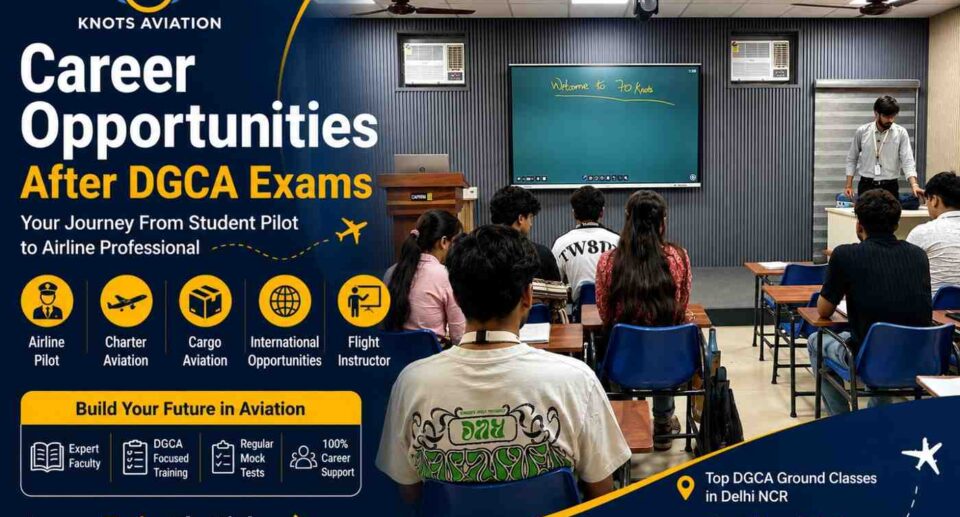
Career Opportunities After DGCA Exams: From Student Pilot to Airline Professional
India’s fast expanding aviation market presents great potential for new pilots and allied aviation professionals. Thousands of students progress through the DGCA Exams every year to enter the aviation industry. Many students are however left pondering what really happens after the completion of these Exams.
Prospective aviators should have knowledge of the Career Opportunities after DGCA Exams and decide which path to pursue. Whether you are aspiring to operate commercial flights, work with charter and cargo aviation or pursue pathways connected with international aviation, this goal can be realized through adequate training and resources.
For students investigating the steps to becoming a pilot, evidence suggests that passing the DGCA Exams is one of the preliminary and critical steps. These Exams not only form the basis of a career as a pilot, but also establish the framework to pursue various career avenues in the aviation industry.
This article aims to highlight the various avenues and career options that can be pursued after the DGCA Exams and details the journey of student pilots aspiring to become airline professionals.
Significance of DGCA Exams
The Directorate General of Civil Aviation (DGCA) is the Indian aviation civil regulatory body. DGCA Exams are an assessment of students’ knowledge of aviation and the various theories that aid the safe conduct of flight operations.
Core subjects would typically include the following:
Air Navigation
This is an Introduction to the theories of System of Flight, Aviation Charts, and Route Calculations.
Aviation Metrology
There is great value in being an aspiring pilot and knowing how weather systems change and their impact on flight.
Air Regulations
Students take a look at regulation of aviation legislature, safety laws, and laws on air traffic.
Technical General
This part focuses on systems and engines and the science of aerodynamics and performance of aircraft.
Technical Specific
Students focus on the specifics of certain aircraft.
Passing these examinations is important in the attainment of the Commercial Pilot License and the beginning of a professional career in aviation.
From Student Pilot to Airline Professional
There is commitment and discipline along with the will to learn more that a flight student turned airline pilot needs.
Complete Ground Training
Students enroll in professional aviation institutes that offer the Best DGCA Ground Classes in India, and prepare them for DGCA examinations.
Pass DGCA
Passing all of the required DGCA subjects shows that students have the required theory.
Complete Flight Training
Students are required to get a number of flight hours through practical flight training.
Obtain Commercial Pilot License
After the required flight hours and passage of all requirements, students are awarded their CPL.
Apply for Open Aviation Jobs
There are numerous opportunities in airlines, charter operations, cargo aviation, and international aviation.
Commercial Pilot Career
Highly regarded and a first choice of many who have attempted the DGCA examinations, is the career of a commercial pilot.
Commercial pilots who are able to operate passenger aircraft via the domestic and international airspaces, have a lucrative career that is secure and offers great returns on the time and investments spent.
Airline Pilots are accountable for:
- Planning and executing flights
- Operating the aircraft and ensuring passenger safety
- Navigating and communicating
- Following aviation regulations
India’s aspiring commercial pilots wish to be First Officers and later Captains in the country’s prominent airlines after completing the Commercial Pilot Training in India and getting their CPL.
With an ever-increasing number of airlines managing larger fleets and a greater number of flight paths, the need for airline pilots is rising.
Charter Aviation Careers
After the DGCA examinations, charter aviation is a lucrative career option.
Charter pilots fly private aircraft for corporate clients, holiday makers, government officials and business travelers. Unlike some commercial airline operations, charter flights are often more flexible and provide a greater diversity of flying.
The charter aviation business has the following benefits:
Diversity in Flying
There are a multitude of locations and airports to fly pilots and staff to.
Professional Interaction
Due to the nature of the business, charter pilots often fly VIPs.
Experience
Flying under a diversity of conditions is great for developing pilots’ skills and experience.
Many aspiring pilots start in charter aviation and then fly for commercial airlines.
Cargo Aviation
Thanks to e-commerce and global trading, the demand for cargo pilots is rising.
Cargo airlines can fly anything from goods and industrial equipment to medical supplies and shipments that are time sensitive.
The cargo pilot business has the following benefits:
Industry Growth
There is a continuous expansion of global logistics and cargo transportation.
Salary
Cargo operators often pay well.
International Flying
Many cargo operations involve long-haul international operations.
For pilots wanting great prospects and secure jobs, this is the business to be in.
Career Options After DGCA Exams
Flight Instructor Careers
Choosing flight instructor career path is a respectable option post-DGCA exams. Flight instructors help future pilots build flying skills & aviation knowledge, as well as help build a professional attitude.
Responsibilities involve:
- Performing flight lessons
- Teaching aviation theory
- Evaluating student progress
- Preparing students for flight tests
- Promoting flight safety awareness
The flight instructor post helps build professional flying hours and aids in shaping future flight professionals.
Corporate Aviation Careers
Corporate aviation is flying private aircraft for corporations, business entities, and executive personnel.
The benefits of being a corporate pilot include:
Professional Environment
Corporate aviation usually means having a structured schedule with modern aircraft.
Global Travel
Corporate pilots fly many international flights.
Career Advancement
There are many opportunities for career growth in corporate aviation.
Pilots who conduct themselves professionally and possess excellent communication skills flourish in this field.
International Aviation Opportunities
The most lucrative career opportunity post-DGCA exams is working outside the country. Aviation is a global industry and skilled pilots are in demand outside India after gaining a bit of experience.
International Aviation Opportunities include:
Foreign Airlines
Pilots can become a part of the airlines flying around Asia, Europe, the Middle East, and beyond.
International Cargo Operators
Numerous logistics companies that operate around the globe are in need of experienced pilots.
Business Aviation
Many corporations have their own private jets for international business and highly skilled pilots are in demand for this.
Flight Training Organizations
Many foreign aviation academies hire experienced instructors.
Aviation is a continuously expanding industry and the allure of international career options is great.
Aviation Management and Ground Operations
Many qualified aviation professionals do not want to remain in the cockpit. DGCA-qualified people can choose aviation management as a career.
Some of the choices include:
Flight Operations Management
Managing operational activities and flight scheduling for airlines.
Airport Operations
Managing services and logistics for an airport.
Aviation Safety Management
Managing safety and compliance in the aviation domain.
Airline Administration
Managing the different departments in an airline and planning operations.
These careers are a good option for people who want to stay in aviation even if they do not want to fly.
Why Choosing the Right Training Institute Matters
Quality aviation training is the cornerstone of a successful aviation career.
When searching for the Best Pilot Training School, students must check for:
Experienced Faculty
Great instructors break down the complicated aspects of aviation for the students.
Up-to-date Study Material
Learning resources are contemporary and in compliance with DGCA.
Frequent Mock Exams
Sample tests help students develop a test-taking strategy and improve their performance.
Career Counseling
Mentorship helps in decision making regarding career options.
Disciplined Training
Basic training teaches discipline which is necessary for aviation.
Access to adequate infrastructure and experienced faculty is why the Best Pilot Training Institute in Delhi is highly popular amongst aspiring pilots.
Importance of Commercial Pilot Training
Professional careers in aviation require real-world as well as theoretical training.
Programs for the Commercial Pilot License in Delhi are highly intensive and cover a plethora of concepts and skills.
A comprehensive training program helps develop the following skills:
- Knowledge of Aviation
- Proficiency in Flying
- Communication Skills
- Decision-Making Skills
- Readiness for Airlines’ Selection
In addition to training, building the above skills provides a strong base for a successful career in Aviation.
Skills Required for Success in Aviation
Passing DGCA exams is just one of the many requirements for building a successful career in Aviation.
As a Pilot, you also have to develop the following skills:
- Communication Skills
- Situational Awareness
- Decision-Making Skills
- Leadership Skills
- Professional Discipline
Following the above skills will ensure you work successfully in Airlines, Charter Services, Cargo Aviation and International Operations.
Growth of Aviation Careers in India
India has one of the world’s rapidly growing aviation markets. More airports, newer airlines with expanded fleets, and increased traffic of people and cargo means a growing number of jobs.
Therefore students who undergo Commercial Pilot Training in India are preparing to enter an industry with great long-term growth potential.
In the coming years, the demand for pilots, flight instructors, aviation safety specialists and managers will continue to grow.
With commitment, training and passing the DGCA exams, the career options for aviation professionals are numerous and diverse, including Airlines, Charter, Cargo, Instruction, Corporate, and International Aviation.
Students considering the steps on How to Become a Pilot should aim to accumulate a good combination of theoretical knowledge, flight training, and mentorship from a Best Pilot Training School or a premier Best Pilot Training Institute in Delhi. Completing a Commercial Pilot License in Delhi or any comparable professional training program will assist aspiring pilots in acquiring some of the skills imperative to achieving their long-term career goals.
Through dedication and the correct form of aviation-based education, dreams of becoming a pilot can be realized and be commercially gratifying, considering the aviation industry is one of the more dynamic and interesting industries to work in.
The 70Knots Aviation team shares informative and practical insights on pilot training, aviation careers, DGCA requirements, CPL training, flight training, and the Indian aviation industry. Through well-researched articles, the team aims to help aspiring pilots, aviation students, and aviation enthusiasts understand training pathways, eligibility, courses, and career opportunities in aviation. As one of the best pilot training institutes in India, 70Knots Aviation provides clear and useful information to support readers at every stage of their journey toward a career in the skies. With a focus on practical aviation knowledge, the team brings together valuable insights to help readers make informed decisions about their aviation education and career.