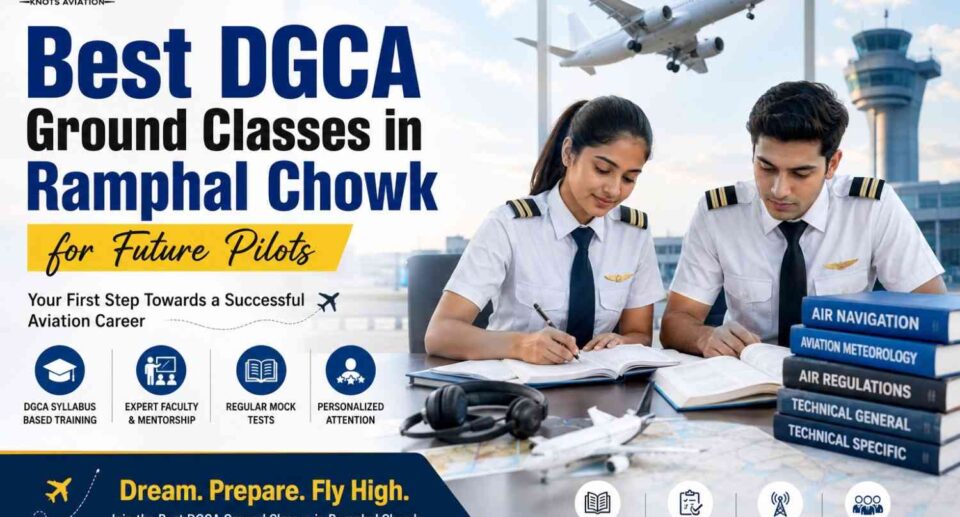
Best DGCA Ground Classes in Ramphal Chowk for Future Pilots
The aviation industry is an ever-growing and attractive industry, and for students considering building a career as a professional pilot, there are numerous entry opportunities. Although, interest in flying and aircraft should not be misconstrued as knowledge, understanding and being familiar with the basics of aviation theory, meeting the applicable medical and educational requirements, passing the relevant examinations and undertaking practical flight training are imperative.
Ground training forms an integral part of pilot training and for students resident in Delhi starting their journey in aviation, Ramphal Chowk, Dwarka is a location for consideration. Before enrolling for any training, it is important to evaluate DGCA aviation training institutes and understand the concepts of examination preparation.
70Knots Aviation is a recognized aviation training institute that aids students in their journey to build their theoretical knowledge of aviation and prepares them for the subsequent stages of their training. This guide encompasses 2026, the subjects, and the regulatory frameworks, preparation and practical methods required.
What are DGCA Ground Classes?
The DGCA is the authority in charge of regulating and overseeing the licensing of flight crew and ensuring aviation safety in India. DGCA ground classes cover theoretical subjects required to be learned and understood by the candidate to facilitate sitting for the relevant DGCA examinations.
There are differences between ground classes and flying training. Ground classes give students the opportunity to acquire a command of theory while flying training develops the skills required to operate an aircraft under appropriate supervision.
Students looking for Best DGCA Ground classes in Ramphal Chowk should look out for programs that facilitate clear understanding of the syllabus, structured practices and help students develop the ability to integrate theoretical knowledge with practical aspects of aviation.
However, it is important for students to understand that attending classes alone will not result in a pilot license. Students have to meet the stipulated requirements for the license they are applying for, which include flying, medical fitness, theory examinations and other assessments.
Importance of DGCA Ground Training
DGCA ground training is an essential component for aspirants of aviation industry for several reasons. First, theoretical knowledge of aviation gives students an understanding of the principles behind the operation of an aircraft and the safety aspects of flying. This knowledge prepares students for theory assessments and trained them on what they require to further their career in practical flying.
Ground training enables students to understand various factors that impact safety of flight including weather, navigation, flight planning and performance. For practical flying, the training offers students a structured way of learning operational regulations and limitations of an aircraft.
A structured learning programme allows students to recognise their weak areas, practice with different types of questions in examination conditions, and work on time management.
3. Building Confidence and Discipline
Training requires regular and consistent efforts. Students should be able to organise their time, be self-directed in their efforts and take responsibility for their progress.
Regular evaluations and clarification of doubts enable students to identify their errors and shortcomings in a timeous manner, consequently adjusting their understanding, and consequently be prepared for examinations.
4. Connecting Theory and Practical Flying
The more meaning and relevance students attach to theory, the easier it is to retain.
Relating theory on weather to practice helps students understand the meaning behind piloted assessments of weather conditions, and why assessments of various conditions are important before every flight.
Relating theory to practical gives a lot of meaning and aids understanding of theory.
Subjects covered in DGCA Ground classes
The particulars of the exams, the licensing category, and the DGCA rules determine what will be the focus and the extent of the examination. Hence students should always refer to the current official syllabus to understand what they will have to study for the examinations.
Some of the topics that form the focus of pilot ground training are
Air Navigation
Aviation Meteorology
The student also acquires an understanding on the role of weather information on flight planning and operational decision-making.
Air Regulations
Air Regulations covers the rules, procedures and legal considerations in aviation. Students must acquire the applicable regulations and learn to identify and locate reliable and recent information.
As regulatory requirements may change, students are encouraged to use the latest official publications that are relevant and the latest applicable examination syllabus.
Technical General
Technical General covers basic knowledge of aircraft and systems, engines and instruments, and the principles of flight and aerodynamics and performance of an aircraft.
Understanding these concepts aids students to appreciate the role of limitations and requirements, procedures and practices.
Technical Specific
Technical Specific is confined to the type of aircraft for which the student is trained and/or qualified, and may include knowledge of the structure and systems of the aircraft. Students should clarify the requisite syllabus and examination for their desired qualification.
Radio Telephony and Communication
At various stages of training and with regard to applicable requirements, students may need to learn radio telephony procedures and practices, and aviation phraseology and related examination and/or licensing requirements.
Students should verify eligibility and current examination procedures and name before applying.
How to choose the Best DGCA Ground Classes in Ramphal Chowk
During preparation for the DGCA ground examination, a student should evaluate and select the training institute that best supports them based on the teaching methods and supplemental study aids offered. The student should compare coverage of the syllabus and the method of instruction.
Experienced and Knowledgeable Faculty
The staff should consist of instructors knowledgeable in the subject area who can give examples related to aviation. Students should feel free to raise their hand and ask for clarification if they do not understand something.
Structured Study Material
Teaching material should be in line with the syllabus and should be revised when necessary. The material for studying should be sufficient enough to explain and give examples and should contain practice questions and revision material.
Regular Mock Exams
The students should get the chance to prepare themselves for the exams and get used to the exam conditions. Effective assessment will help the students to see where their mistakes lie and which areas they should study more.
Doubt-Clearing Support
Instructors should encourage and be available for sessions to answer student questions.
Individual Progress Monitoring
Some students find certain areas difficult and may require numerical practice, while others may need a change in their revision strategy. Individual progress reviews should address these different requirements.
Transparent Guidance
An institute should have no problems explaining its fees and course details. Be wary of institutes that guarantee students an airline job and/or pilot license.
When making comparisons between the top pilot training institutes in Ramphal Chowk, distinguish between ground schools and flying schools since they are two different types of services.
Ground Schooling in Ramphal Chowk, Dwarka?
Ramphal Chowk, in Dwarka, Delhi could be a good place for those who stay in Dwarka and surrounding areas of the national capital region.
Students must consider the daily commute, timing of classes, available means of transport, and the time available for studies, before taking admission.
Location is just one factor in evaluating an educational program. Teaching and other support processes remain important.
Prospective students may wish to contact 70Knots Aviation to understand their ground training programs, and to evaluate their teaching and other course process related aspects, before taking a decision to enroll.
Understanding the Pilot Training Journey in 2026
Prospective students must understand the main requirements before making the commitment of time and money.
Step 1: Check Your Educational Eligibility
Candidates wishing to take up training for a Commercial Pilot License (CPL) should have the prescribed 10+2 or equivalent level education with Physics and Mathematics as compulsory subjects.
In case candidates have not studied Physics or Mathematics at 10+2 level, they need to understand acceptable ways to satisfy this requirement and take the training only after confirming.
Step 2: Check Your Medical Fitness
Medical fitness of a candidate is of prime importance for training to become a pilot. Therefore, candidates should ensure that they satisfy all the DGCA medical requirements and take the required assessments through the prescribed means.
It makes sense to start considering medical eligibility early as individual cases can restrict training pathways.
Step 3: Complete the Relevant Registrations and Examinations
Candidates should refer to the most up-to-date instructions, user guides and advisories as given on the official DGCA Pariksha portal.
Pariksha is an online examination and registration portal. It is important to understand the difference between the portal and the aviation subject, and the assessment and licensing process for a pilot’s licence. Notices and time tables are published on the portal and should be checked regularly by the candidates.
Step 4: Undergo the Required Flying Training
When the prerequisites have been satisfied, candidates undergo flying training that is practical and relevant to the licence they are seeking. This may include flight experience, training, assessment and other licensing conditions.
Students are required to confirm the latest requirements from the DGCA and their flying training organisation to plan their route to a Commercial Pilot Licence (CPL).
Step 5: Meeting Other Licensing Requirements
It is vital to note that there are some other licensing requirements that need to be met apart from the passing of the required tests. These include flight experience, fitness, evaluations, and documentation.
Details of the complete process and pathway can be verified against the latest DGCA rules and notices.
Student-Counselor Discussion on Planning for Pilot Training
Student: I want to become a commercial pilot. Is it better to start with flying lessons or with ground lessons?
Counselor: First determine the complete licensing pathway. Then ascertain your educational and medical eligibility and prepare accordingly for the required training. Ground lessons are available to help students prepare for the examinations.
Student: What courses should I start with?
Counselor: Start with lessons according to the syllabus relevant to your exam type. Some courses, for example, Air Navigation, would benefit from practicing your numerical abilities, while some courses will need more conceptual learning like Meteorology or Air Regulations. It should depend upon your strength and weakness.
Student: Is it enough to join a institute to clear the exams?
Counselor: No Institute can guarantee your success. Constant assessments by the Institute should help you evaluate your progress.
Student: How do I evaluate if an Institute is right for me?
Counselor: Evaluate if the Institute has an appropriate faculty, covers the complete syllabus, provides a generous schedule of tests and study materials, and charges a reasonable fee.
Student: What should I evaluate before I apply for DGCA Exams in 2026?
Counselor: Refer the DGCA Pariksha portal. Go through the latest Notification/ circular, User Manual, FAQs and Online Application process, deadline, examination schedule and fee, requirements and documents.
Careers After Pilot Training
Completing the ground classes is an educational milestone. A pilots professional qualification is defined by the licenses, ratings and experience he/she obtains later.
Commercial Pilot Licence (CPL)
With additional qualifications and experience (if required by the employer) an pilot can apply for employment with an airline. Employment with an airline is based on the airlines operational requirements, the candidate’s qualifications and experience as well as other factors.
Charter Pilot
A commercial pilot can apply for jobs as a charter pilot if he/she meets the operational and experience requirements of the employer.
Flight Instructor
A pilot can obtain instructor qualifications and provide flight training if he/she meets the regulatory and experience requirements.
Other Career Options in Aviation
Apart from flight training, students may consider careers in Flight Operations and Aviation Safety. Each career has its own eligibility and training requirements. Students should research the pathways and requirements for each career.
Study Aids for DGCA Exams
Study aids are available for sale. Students should become familiar with and study from the official DGCA notices, syllabus and reference materials.
Balance theory with understanding: Understanding the reasoning behind a principle is much better than blindly memorizing the answer.
Students are advised to regularly check the official announcements, as dates for the examinations, registration windows, and administrative instructions are subject to change.
Frequently Asked Questions
1. What are DGCA ground classes?
DGCA ground classes are taught sessions to assist students to acquire the theoretical knowledge required to pursue their licensing requirements. These classes do not comprise of practical flying training and other requisite licensing requirements.
2. How can I select the Best DGCA ground classes in Ramphal Chowk?
Evaluate the faculty, coverage of syllabus, teaching methods, mock tests, study material, doubt clearing, fees and timing.
3. Does 70Knots Aviation provide a pilot licence after ground classes?
Ground classes assist students to gain theoretical knowledge and prepare them for the examinations. Students are also required to fulfill all the requirements prescribed by the DGCA, to include the required examinations, medical fitness, flying experience and other assessments. It is advised to verify the services offered by the institute directly.
4. Is Ramphal Chowk a good location for Aviation Ground training?
It is conveniently located for residents of Dwarka and surrounding areas. Students are advised to judge a training programme on quality and other parameters rather than choose a programme based on the location of the training institute.
5. Where can I get the latest information about DGCA examinations in 2026?
The DGCA Pariksha site has the most recent alerts, schedules, registration information, admit cards and results for various examinations. Keep up with the latest from the DGCA.
Conclusion
A career as a pilot begins with the right decision and consistent effort throughout the process of licensing. DGCA ground training prepares the students for theoretical knowledge required for various examinations and prepares them for the initial stages of practical flight training.
When selecting the best pilot training institute in Ramphal Chowk, one needs to look at the methodology, faculty, course content and assessment, and the support provided to students. Additional factors include your eligibility for higher studies, medical fitness and recent instructions from the DGCA.
Lastly, students may also opt for 70 Knots Aviation for training on the ground in Ramphal Chowk. Go through the syllabus and the faculty to decide whether they meet your requirements.
Essential pointers for students- making a proper study plan, revision, and keeping yourself updated with the latest DGCA notifications is crucial for success. An analysis of the entire process will aid the students in taking the right step towards their career in aviation.
You might also find this blog useful :
The 70Knots Aviation team shares informative and practical insights on pilot training, aviation careers, DGCA requirements, CPL training, flight training, and the Indian aviation industry. Through well-researched articles, the team aims to help aspiring pilots, aviation students, and aviation enthusiasts understand training pathways, eligibility, courses, and career opportunities in aviation. As one of the best pilot training institutes in India, 70Knots Aviation provides clear and useful information to support readers at every stage of their journey toward a career in the skies. With a focus on practical aviation knowledge, the team brings together valuable insights to help readers make informed decisions about their aviation education and career.