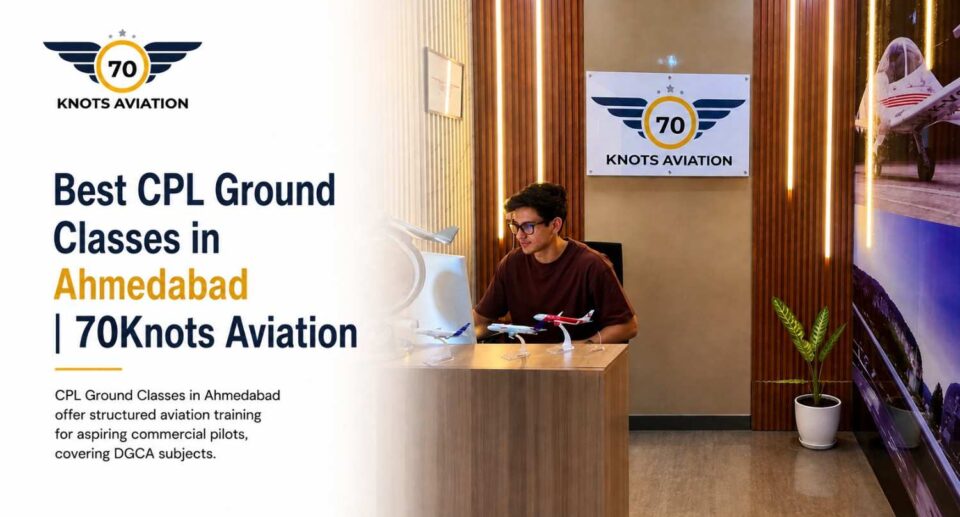
Best CPL Ground Classes in Ahmedabad

Since time immemorial, the aviation industry has called to those who dream of not just flying, but building a career and profession in the skies. However, there is much more to becoming a commercial pilot than learning the art of flying. There is a need for strong, disciplined, and driven theoretical knowledge and a pragmatic approach and guidance along the way.
Before students govern the cockpit of an aircraft professionally, there are many aspects of the aviation industry and flying they need to know. These include knowledge of the systems and the various components of an aircraft, navigation and its techniques, aviation weather and how it is forecast, flight and its various planning techniques, and the laws and regulations of the aviation industry. This structured knowledge is achieved through adequate ground training.
For those searching for CPL Ground Classes in Ahmedabad, the right aviation training institute is one of the most important career decisions. A well-organized ground school program prepares students for the DGCA exams and provides the basis of the technical knowledge that will be required in the profession.
For many coming to Ahmedabad to pursue a career in aviation, the educational ambience combined with excellent connectivity, and increasing opportunities is a big draw. Many from the neighboring states of Gujarat can easily access the high quality aviation training that the city offers.
70Knots Aviation believes in teaching with an aviation oriented flow that helps students to clear CPL subjects in a systematic manner. Our aim is not just to help students to pass, but to build and strengthen flying related concepts that will last for the entire flying career of the students.
The Importance of CPL Ground Training in Preparing Pilots
Students aspiring to be pilots typically concentrate on aspects of flight training. Actual flying is important, but the safety of aviation relies on an individual’s theoretical knowledge and preparations.
As the person in charge of the flight, a pilot has to make a number of important decisions, which rely on the knowledge of the weather, the performance of the aircraft, the methods of navigation, fuel, and the regulations of the air.
CPL ground training introduces the air legislation and the science of flying to students as part of the theory subjects established by the Directorate General of Civil Aviation (DGCA).
A good ground training program benefits students in the following ways:
- Fundamentals of aviation
- Arrangement of studies for the DGCA exams
- Understanding aviation in a professional capacity
- Advanced skills in theory and application
Students learn to integrate air regulations and the science of flying with practical flying well before the other students.
Students who have the fundamentals of aviation and air regulations and the science of flying during ground school find it much easier to integrate with practical flying.
Advantages of Being in Ahmedabad for CPL Ground Classes
Ahmedabad is the largest city in the state of Gujarat and has established itself in growing trade and centers of education and technology. The facilities and the opportunities that Ahmedabad offers, attract students from many regions.
Ahmedabad has appreciable aviation connectivity via the Sardar Vallabhbhai Patel International Airport. Thanks to the airport, major cities are easily accessible, and students can learn about various job-related aviation services.
The following students can use Ahmedabad to pursue aviation education
- Gandhinagar
- Vadodara
- Anand
- Mehsana
- Rajkot
- Surat
- Nadiad
Choosing CPL Ground Classes in Ahmedabad will help students execute their dream of becoming a Pilot in a balanced, meaningful, and attainable way. Aviation education is not easy and involves several travel inconveniences.
Ahmedabad is a student-friendly city. It has all the necessary facilities, including educational institutes, transportation, and accommodation. Therefore, students pursuing professional courses can easily settle in Ahmedabad.
What Makes CPL Ground Training Different From Regular Aviation Learning?
CPL ground training is different from ordinary classroom-based training.
Training for aviation CPL ground learning takes a serious, in-depth, and accountable approach in a professional manner.
There is little room for error in aviation. The slightest mistake by a Pilot can compromise the safety of everyone on the flight and therefore every aviation-based profession has a great deal of responsibility.
Thus, CPL ground learning is far beyond basic aviation training and involves learning highly specialized and advanced concepts. This learning is structured and professional.
Students learn how to examine the following:
- The functions and the elements of Aircraft Systems
- The methods used by pilots to plan a flight
- The effects of different weather conditions on aircraft operations
- The effects of laws and regulations on the decisions of personnel
- The effects of operational conditions on the performance of an aircraft
When students transition from the classroom to the flight training environment, this knowledge will prove invaluable.
Key Topics in CPL Ground Classes
CPL training comprises many subjects that are important for acquiring the knowledge necessary to work in the profession. All the subjects deal with the students’ future tasks as pilots.
Air Navigation: The Art of Planning a Flight
Among the CPL subjects, Air Navigation is one of the most significant. This is where students learn how to deal with questions such as the pilot’s methods for locating an aircraft, how to plan a course, and how to compute distance as well as safe navigation.
Flight training will also teach students that map reading is hardly the primary function of navigation. Rather, navigation is the integration of many other factors such as the fuel on board and the prevailing weather as well as the movements of other aircraft.
Students learn:
- The theory of navigation
- The art of planning flights
- The selection of routes
- The calculation of time and distance
- The interpretation of navigation charts
- The establishment of position
Students will discover that a pilot cannot possess navigation knowledge of a low standard if a flight is to be carried out under optimal conditions. As a result of the knowledge of navigation students will also gain confidence with the practice of flying.
Aviation Meteorology: The Study of Weather and Flying Safety
A vital concern for a pilot is how the weather will interact with flight safety. As a result of the impact on the safety of the flight, a pilot must have a knowledge of the behavior of the elements of the atmosphere before he can undertake the task of controlling an aircraft.
Meteorology in Aviation begins to teach students about
- Weather cycles
- Clouds
- Winds
- Temp
- Visibility
- Weather assessments
For example, large winds, storms, and low visibility can all adversely affect flight. A pilot is expected to understand this and act accordingly.
This primarily aims to teach students how environmental conditions impact flight and how they impact the function and performance of the aircraft.
This is known as Air Regulations and is the learning of Aviation Rights and Duties.
The industry of Aviation is heavily regulated in order to keep a uniform standard of safety across the globe. Air Regulations focuses on the rules and the order that the world of Aviation operates under.
This consists of the study of:
- Aviation bodies
- Regulations of flight
- Duties of pilots
- Orders of Air Traffic
- Safety Protocols
The future pilots of the world need to know the laws of Aviation before they can fly.
A pilot needs to know aviation, but also needs to know the duties and rights they have when they are in the cockpit, flying.
This is Technical General Knowledge and it is the learning of Aircraft Systems.
Aircraft are very advanced and very detailed pieces of machinery. Pilots need to understand how to operate one of the very advanced and detailed pieces of machinery.
Technical General Knowledge covers the study of:
- Aircraft engines
- Flight instruments
- Electrical systems of an aircraft
- Structure of an aircraft
- Flight Controls
The understanding of these concepts is essential to comprehend how aircraft function and how to converse with personnel of Aviation, like Engineers and Technicians of Maintenance.
Because of a pilots understanding of this, they can make informed and optimal choices on the course of action during flight.
This is the study of how the performance of an aircraft is impacted and the Planning that stems from that.
This knowledge is essential to comprehend how flight operations function.
There are several factors involved in aviation decision making, which are the weight of the plane, fuel, weather, and runway lengths.
The topics students will be taught are:
- Weight and balance
- Limitations of the aircraft
- Fuel management
- Performance requirements
It is through this topic that the students will get the chance to know the limitations of the aircraft and how they help in the safety of flight planning.
Right CPL Ground Classes in Ahmedabad
Selecting the right aviation academy is the first step in the commercial pilot course of every student. Good ground training will affect the student’s understanding of the basics of aviation and also their preparedness for DGCA examinations.
While searching for Best CPL Ground Classes in Ahmedabad, students should take into account several factors besides the syllabus being offered.
There are multiple things that can impact students’ decisions.
Experience of the Faculty and Their Teaching Style
Aviation subjects have theoretical components and students can find then challenging to grasp. The challenge for instructors stems from the need to move beyond the teaching of a chapter.
Students are aided with the teaching of theoretical components of the subject in the following ways:
- Simple explanation of challenging concepts
- Theory connected to practical aviation examples
- Clear resolution of doubts
- Guiding the students in preparation for the examination
An effective and experienced instructor is one who conveys the rationale for concepts to the students and does not rely on rote learning.
For instance, learning about performance characteristics of aircraft is easier with an understanding of how aircraft respond to varying situations instead of rote memorization of performance equations.
Structured Learning Program
Preparation for the CPL includes a number of different subject areas, each of which must be continuously worked upon. Failure to plan properly might affect students’ ability to progress steadily.
The structured training program includes the following:
- Inclusion of full syllabus
- Continuous revision of syllabus already studied
- Practice
- Examination preparation
- Development of underlying concepts
The training programs opted by students should include a planned manner of learning, as opposed to random selection of topics.
Planning learning helps in relieving students of unnecessary pressure before the examination and in acquiring knowledge gradually and methodically.
Learning Aids
Studying is essential for preparation for the CPL. Subjects related to aviation require continuous revision due to the requirement of concepts and their applications.
Quality training support includes:
- Private tutoring
- Practice questions
- Revision resources
- Concept clarification
- Examination support
Frequent practice of mock examinations shows students where they need to improve prior to the real exam.
Constructing an Effective CPL Study Plan
CPL preparation requires commitment and perseverance. Each student has their own pace, but there are many strategies that can make the process easier.
A practical preparation journey can be segmented into each of the following.
Stage One: Understanding the Basics of Aviation
During this initial stage of preparation, the focus should be on developing the knowledge of the basics.
This entails learning about:
- Aviation lingo
- Fundamentals of aircraft
- Basic principles of flight
- Framework of the subject
Hastening through the topics would only be counterproductive. It is important to have a proper understanding of fundamentals, as it would help understand advanced topics in the future.
Stage Two: Proper Preparation of the Topic
Students can start learning in depth after having a complete grasp of fundamentals.
Proper preparation in this stage would include:
- Grasping of concepts
- Taking personal notes
- Math practice
- Revising of concepts
Mathematics would be an integral part of certain subjects such as Navigation and Aircraft Performance.
Stage Three: Reviewing and Practicing for Exams
Revision is vital in preparation for DGCA. Completed topics should be revised regularly and not left until the completion of the course.
Revision should be done through:
- Practice questions
- Reviewing tough concepts
- Simulated exams
- Mistake evaluation
This greatly increases confidence and gives the student a clear understanding of the level of preparation.
CPL Preparation Common Issues
Aviation students usually begin their journeys with lots of enthusiasm. There are common mistakes that slow progress.
With good understanding of the issues, it’s easy to ignore them.
Not Researching Before Selecting Institute
Students tend to sign up with a school based on ads/promises and little to no personal evaluation.
Students should examine these with care:
- Teacher qualifications
- Teaching approaches
- Course content
- Support to students
Quality of education should be the focus and not the marketing, so look for signs of both.
Disregarding Challenging Subjects
Students have varying levels of interest, capability, and motivation. Avoidance of challenging subjects can be detrimental to students during their exam prep.
Students should:
- Recognize their deficiencies
- Ask for help
- Practice
- Spend time dedicated to subjects
Spend time regularly to achieve improvement rather than cramming for the exam.
Concentrating on Just Passing the Exams
It’s true that the target is clearing the DGCA exams, but the limitation of Aviation training to just exam prep is also detrimental.
Knowledge of the profession, as well as the practical application for that knowledge, will be required to be a successful and effective pilot.
Students should strive to learn both the academic and practical components of the profession for the duration of their aviation career.
Aviation Related Lack of Discipline
As a profession, Aviation is one which will be both responsible and demanding of a great deal of discipline. The aviation profession expects students to be disciplined and develop professional work habits during their training.
These habits include:
- Study consistently
- Practice effectively
- Learn modern advancements in the aviation industry regularly.
Online vs Traditional CPL Ground Training
With the constant growth in educational technology, students have additional methods of their choice for CPL preparation.
Both methods of training have their benefits, and this is determined on an individual basis.
Advantages of Classroom Training
Classroom CPL training affords students the opportunity of learning by being in the presence of training instructors.
These can be:
- Clarity of doubts on the spot
- Discussions in the classroom
- An organized framework for learning
- Interaction with other aviation students
If a student enjoys learning in a more traditional environment, classroom training is the more effective method.
Advantages of Online Training
Convenience and the ability to control the pace of the training is the main benefit of online training for CPL.
Flexible study schedules, distance from training locations, and the ability to learn at their own pace are the factors that online learning can assist students the most with. Online learning gives students the ability to revise lessons and organize their studies when it is most convenient.
Choosing the Right Learning Method
The best method for learning can be different for each student. The best learning method for them can depend on the following:
- Course of study
- Studying habits
- Personal schedule
- Desire for teacher presence
Some students thrive in learning that is more rigid. Others are more successful with learning that is more flexible.
The presence of quality instruction and the opportunity for preparation is what is most important.
Practical Tips for DGCA CPL Examination Preparation
Discipline, understanding, and practice are the biggest factors for preparation for the DGCA examinations.
The following tips can help students with the preparation:
Understand Concepts Before Memorizing
The subjects in aviation can be interrelated. Understanding the reasoning for a concept can help with retention.
A great example of this is the memorization of navigation formulas. It is important to understand the calculations and how they will be applied to a flight.
Develop Short Revision Notes
The ability to create personal notes aids the ability to quickly revise for an exam.
Example notes can include for an exam:
- Definitions
- Important formulas
- Complex ideas
- Causes and effects of frequently reviewed issues
Regular Practice
For both speed and accuracy, practice is very important. Preparation can include practicing:
- Answering
- Mock tests
- Revisions on a topic
Maintain Consistency
It can be more effective to study for short periods of time when the studying is done on a consistent basis.
Students retain information better with a consistent method.
Career Path After Completing CPL Ground Training
CPL ground training is one step to a long process required to become a commercial pilot.
There are other stages after one completes theoretical instruction. They must continue with practical instruction, and then proceed with the professional development aspects.
The process, in most cases, entails:
- Training in the CPL theoretical subjects
- Passing the relevant DGCA tests
- Completing the practical training
- Gaining the necessary hours of flight time
- Getting ready to pursue job opportunities within the aviation industry after gaining the required hours
Knowledge of the ground will be essential in all steps of the process, as the pilots will regularly have to apply such knowledge to the situations they will encounter in the course of their work.
How 70Knots Aviation Supports CPL Aspirants
The selection of an aviation academy is an important step, as the environment of the academy can influence how the student prepares.
70Knots Aviation strives to facilitate the CPL ground preparation of pilots in a disciplined, yet flexible, manner, so that they have more solid aviation fundamentals than the pilots of other academies.
The academy tries to provide to its students:
- Learning that is centered around aviation
- Learning of the subjects in a structured manner
- Instructions of the requirements of the CPL in a stepwise manner
- Learning through the formation of concepts
Students who search for Top CPL Ground Classes in Ahmedabad should also consider the quality of teaching, facilitation and support to the students, the professionalism of the faculty as well as long-term career services that are offered by the institutes, before selecting an aviation academy.
Aviation is one of the industries where the building of strong, solid fundamentals ensures success in the profession for a long time. Well-articulated ground training enables the students to acquire the knowledge, confidence, and discipline that is required to render their services to the industry in the capacity of professional flying.
FAQs on CPL Ground Classes Ahmedabad
Q1. What are CPL Ground Classes Ahmedabad?
CPL Ground Classes Ahmedabad is an aviation training program to make the student ready for the theoretical part of the Commercial Pilot Licence.
Q2. Why do I need ground training before becoming a pilot?
Ground training will help you gain knowledge about aviation subjects, prepare for DGCA exams, and make you prepared to fly safely.
Q3. Which subjects are covered in CPL ground class training?
The main subjects covered under the CPL ground class training include Air Navigation, Aviation Meteorology, Air Regulations, Technical General Knowledge, and Aircraft Performance.
Q4. How can I select the Best CPL Ground Classes Ahmedabad?
Before selecting an institute, it is best to consider the experience of the faculty, course curriculum, methodology, resources for study, and help in preparation for examinations.
Q5. Can students from other cities come for CPL training?
Yes, the aviation training classes are available for students from other cities of Gujarat and nearby regions due to the connectivity of Ahmedabad city.
Q6. Are online CPL classes effective?
CPL classes online may prove to be successful if students have a disciplined routine for their study and get proper guidance.
Q7. What is the time frame for CPL ground preparation?
Time frame varies based on the learning pace of the individual student and the way he/she studies.
Q8. Is there preparation for DGCA exam in CPL ground classes?
Yes, the main aim of CPL ground class is to make the students comprehend subjects needed for DGCA exams.
Q9. What will students do after CPL ground classes?
Students after completing CPL ground classes move ahead with flight training and license requirements.
Q10. Why is selecting the right CPL academy crucial?
Right CPL academy will help students create good concepts, prepare well and gain professional knowledge in aviation.
The 70Knots Aviation team shares informative and practical insights on pilot training, aviation careers, DGCA requirements, CPL training, flight training, and the Indian aviation industry. Through well-researched articles, the team aims to help aspiring pilots, aviation students, and aviation enthusiasts understand training pathways, eligibility, courses, and career opportunities in aviation. As one of the best pilot training institutes in India, 70Knots Aviation provides clear and useful information to support readers at every stage of their journey toward a career in the skies. With a focus on practical aviation knowledge, the team brings together valuable insights to help readers make informed decisions about their aviation education and career.