
CPL and DGCA Ground Classes in Ghaziabad

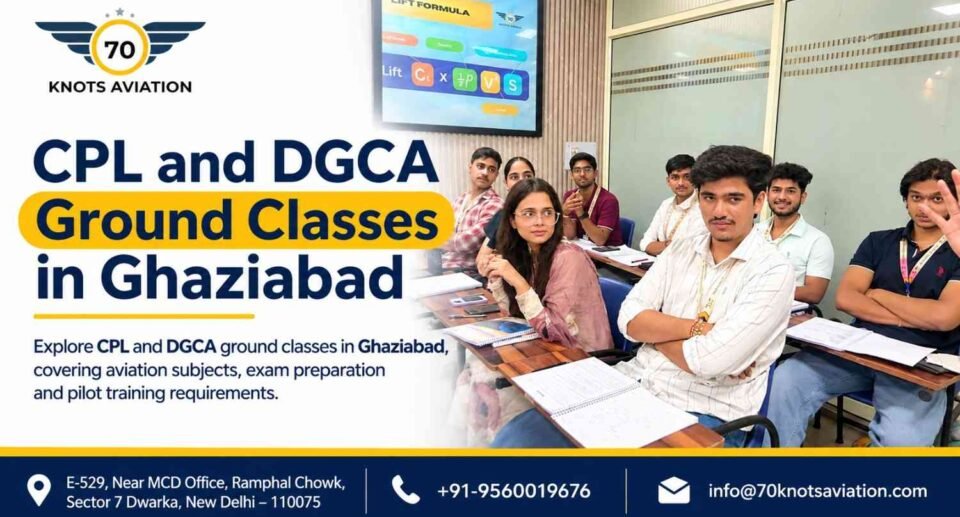
Students in Ghaziabad who wish to pursue a career in commercial aviation need to understand the training process to become eligible to take the theory examinations conducted by the Directorate General of Civil Aviation (DGCA). It is an interesting and exciting career where you get to work in a disciplined and well organized environment.
Becoming a commercial pilot requires more than just flying an aircraft. Aspirants need to have a thorough knowledge of different concepts of aviation including navigation, meteorology, and other aspects of aviation law and the functioning of the systems of an aircraft. They will then be progressively issued with various licenses to allow them to fly various types of aircraft.
Classes conducted by cpl and dgca in ghaziabad can help students prepare for the theory examinations conducted by the DGCA. These classes are generally conducted by trained faculty members and are intended to help students understand theory concepts of aviation.
70Knots Aviation Academy, conducts ground training for students on aviation and helps students prepare for the theory examinations conducted by DGCA. Our objective is to teach aviation concepts to students instead of them simply memorizing the concepts.
Awareness about the various aspects of ground training will assist students to understand what is required to pursue a career in aviation.
Students learn about scientific, technical, and regulatory aspects of flying an aircraft in these classes. This helps students to prepare for the DGCA theoretical examinations.
What Are DGCA Ground Classes?
Students enrolled in DGCA ground classes study subjects such as navigation, air navigation, meteorology and flight planning and regulation. All these subjects are a part of training required to obtain a commercial pilot license.
Attending CPL ground classes in Ghaziabad means students study topics such as aircraft performance, navigation and weather, as well as aviation regulations.
Ground training and flying training are the two distinct components of training a commercial pilot.
- Ground training: This component of training provides students with the theoretical knowledge of various aspects of flying.
- Flying training: This aspect of training focuses on practical aspect of flying.
Successfully completing ground training classes does not entitle the student to a commercial pilot’s license. Pilots have to make numerous decisions based on their knowledge of the limits of the aircraft and their interpretation of various regulations and weather reports. They must understand the many factors that affect flight requirements and navigation. Decisions about the appropriateness of weather conditions for flight, fuel planning and navigation are all assessed by the pilot before flight. Knowledge about these factors is developed during ground training. Thorough preparation for these subjects also helps students with confidence when taking related theory examinations. Attending these classes in Ghaziabad can help students learn in a structured way and assist them to identify the aspects of the subject they need to study further.
Conceptual understanding of various aviation subjects is particularly important because they are interconnected. Students with a strong foundation in the concepts underlying a particular subject are better equipped to respond to a variety of questions in that area and also to apply their knowledge to practical situations outside the context of an examination.
Which Subjects Are Covered In DGCA CPL Ground Training?
There are numerous subjects that together comprise DGCA CPL ground training. Each of these subjects covers a different aspect of aviation knowledge.
Air Navigation
Air Navigation explains how an aircraft determines its position and what aids are used for flight routing and navigation. Some of the topics included here are:
- Terms related to direction, bearings and headings
- Methods of time, speed and distance calculation
- Concepts of flight planning and navigation
- Variations in winds and their effect on flight paths
Students must understand various principles of air navigation in order to calculate the corrections to be applied to an aircraft’s flight path to maintain it on the planned route.
Aviation Meteorology
Aviation meteorology deals with various aspects of the atmosphere which may impact aircraft operation. The topics covered in this area include:
- Trends of wind and temperature aloft
- Various types of clouds and precipitation
- Methods of forecasting weather
- Fog
- Turbulence
- Thunderstorms
- Weather reports
Air Regulations
Air Regulations covers the legal aspects and operational aspects of civil aviation and includes various air navigation rules, airspace classification, air traffic control services and flight crew duties.
Students studying this area also become familiar with the role and functions of various civil aviation regulatory authorities including the DGCA.
Technical General
This area explains to students various scientific and engineering principles, concepts and factors on which an aircraft is designed and operates.
Topics cover:
- Principles of flight
- Aerodynamics
- Structure of aircraft
- Flight controls
- Aircraft engines
- Electrical systems of aircraft
- Instruments of aircraft
- Related principles of performance
It is imperative that students understand the principles of lift, drag, thrust and weight to comprehend the aspects of flight and the performance of an aircraft in relation to flight.
Technical Specific
This segment deals with the systems and components of an aircraft relevant to the requirements of the examination in question. Students cover the characteristics and limitations of systems and components of the aircraft including instruments and performance.
How much a student prepares, depends on the aircraft and the requirements of the DGCA examination.
RTR (A)
Radio Telephony Restricted (Aeronautical) refers to the use of Aviation Radio by pilots. Knowledge of this area helps candidates to understand how to effectively communicate with Air Traffic Control, other Aeronautical stations and pilots in the vicinity. This topic is especially relevant as the candidate is required to learn standard phraseology and communication procedures used in aviation. It is prudent for the candidate to check the current licensing and examination requirements prior to preparing for an examination to avoid any unnecessary time wastage.
What Should Students Know Before Attending CPL Ground Classes in Ghaziabad?
Students should know the educational qualification required to become a commercial pilot in India and compare it with their educational and career goals before applying for commercial pilot training in Ghaziabad. Applicants must have cleared Class 12 with Physics and Mathematics or its equivalent.
Students not familiar with these areas must first check the available recognized routes to qualifications before taking further action. Students must build their skills in maths, algebra and geometry and become more comfortable with units and conversions in order to perform various calculations in air navigation and other technical subjects. Understanding basic concepts of physics such as motion, force and pressure, will also help in understanding aircraft and related systems.
Aviation involves many costs which students should be aware of including fees for ground and flight instruction, exam fees and medical assessments. Aspiring pilots must also meet the necessary medical standards to obtain a license.
It is strongly recommended that students obtain a basic understanding of aviation related subjects in order to have a more realistic expectation with regards to the duration and level of detail of aviation ground training. This understanding will help students better assess the viability of taking DGCA ground classes in Ghaziabad to prepare for the DGCA licensing examinations.
How Can DGCA Ground Classes in Ghaziabad Help Students?
DGCA ground classes in Ghaziabad can prove to be very helpful for students in clearing their concepts and solving theory and numerical problems in an organized manner. Below are a few key aspects that students should implement in their preparation:
- Understanding the principles of various concepts related to aviation.
- Doing plenty of numerical problems and other subject related problems.
- Clearing doubts with the instructor.
- Revisiting previously covered topics.
Understanding the examination pattern and syllabus allows students to manage their time effectively for each subject.
Time Management
Knowing the difference between DGCA Pariksha and DGCA Exams is very important.
Pariksha is the website through which students register and select their exam slots. It is not the exam itself.
There are several theoretical aviation subjects which are assessed through DGCA examinations.
Here at 70Knots Aviation Academy we motivate our students to revise and practice questions outside of the classroom. There is a need for students to understand the CPL process.
Understanding the Complete CPL Training Process
Ground classes comprise only a fraction of the CPL training process. Understanding how different aspects of CPL training are integrated is very important.
Following is a brief description of some of the phases of CPL training.
- Completion of mandatory educational qualification including physics and mathematics at the 10+2 level or equivalent.
- 1. Completion of medical assessments required for the DGCA Class 2 and Class 1 medical examinations.
- Preparation and study of various theoretical subjects related to aviation.
- Appearing for the DGCA examinations.
- Receiving flying training from an authorised flying training organization.
- Obtaining the required experience and skill by undertaking flying hours, skill tests and other assessments relevant to the license.
- Obtaining the commercial pilot’s license by applying to the DGCA.
Students need to understand that not every requirement will be done in the same exact order and way that is listed here.
Understanding this will help students avoid having unrealistic expectations about the financial commitment and the time and preparation that will go into this endeavor.
How to Assess an Aviation Ground Training Academy
Choosing the right training academy to prepare you for a flying career is very important. Inadequate theory training during the initial stage of your career may adversely affect your understanding of various concepts of aviation.
Prior to enrolling in any academy providing DGCA and CPL ground classes in Ghaziabad, consider the following.
- Approach of the Instructors: Check if the instructors provide examples to illustrate the concepts to students.
- Subjects Covered: Find out if the academy teaches all the relevant theoretical subjects of the CPL course.
- Doubt Resolution: Addressing students’ doubts and providing examples on difficult concepts.
- Resources: See what type of study and practice materials the academy provides.
- Provide a peaceful environment for study and help students inculcate study discipline.
- Explain their course fees, teaching methodology and limitations of ground training clearly.
Do not take admission in an academy based on their advertisements and promises of getting you through the next exam. Check out what kind of learning support they provide.
How 70Knots Aviation Academy Helps New Aspiring Pilots
Given the initial complex nature of the aviation industry, new students often feel overwhelmed and confused. The aim of our ground training is to simplify difficult concepts and use illustrative examples to make various aviation related topics easier to understand.
We provide support in areas such as:
- Explanation of aviation concepts.
- Preparation for DGCA theoretical exams.
- Interpretation of aviation terms.
- Resolution of navigation and numerical problems.
- Discussion on aviation regulations and principles.
- Commercial pilot training process.
Our goal is to assist students to build a sound theoretical knowledge base before commencing on their training to become a commercial pilot.
If you are interested in dgca ground classes in Ghaziabad, you should also look at training opportunities in Delhi.
Important Considerations for Aspiring Pilots
Prospective candidates may also consider other factors, including:
Medical: While preparing for the ground classes, prospective candidates should also take care of the medical fitness requirements prescribed by the DGCA. An applicant should possess DGCA’s class 2 medical to appear for the class 1 medical, which is a mandatory prerequisite for issuance of a CPL. Information on the latest DGCA medical requirements and authorized medical examiners may be obtained from www.dgca.gov.in.
Theoretical exams: Students are required to clear the respective DGCA theory exams prior to obtaining a commercial pilot’s license. Merely attending ground classes does not suffice.
Flying training: Students are required to complete flying training from an appropriately authorized flying training organization (FTO). While making their choice of FTO, students should also take into account the current authorization of the FTO, training and equipment available with the FTO, and cost of training.
Licence requirements: A CPL involves meeting the prescribed requirements of theory exams, medical fitness, flying experience, skill tests and documents. Students should go through the latest DGCA norms before taking any decision on training.
These requirements emphasize the need for students to take up aviation training as a profession, rather than taking a short-term course.
Preparation for a Career in Commercial Flying
Obtaining a commercial pilot’s license requires a high level of discipline and patience. Students need to develop and improve numerous skills such as communication and decision making to supplement their technical knowledge.
Preparation for a long term career in aviation should begin with thorough, realistic planning. Prospective students should perform research on flying training organizations, prepare financially and maintain consistent level of study to understand licensing requirements.
Those taking interest in cpl ground training in Ghaziabad should look into other aviation training facilities in Delhi and NCR as well.
At 70Knots Aviation Academy, we believe that thorough ground training can form the basis for a solid foundation for a career in aviation. Sound theoretical knowledge can also facilitate advancements in practical flying training.
Student-Counsellor Conversation
Student: I live in Ghaziabad. Can I attend ground training courses in Ghaziabad to become a commercial pilot?
Counsellor: Definitely. Students can look into available aviation ground training in Ghaziabad and surrounding locations including Delhi. Your current residential location should not impact your interest in pursuing an aviation career.
Student: What will be taught in CPL ground classes?
Counsellor: You’ll learn about the various theories of flying like Air Navigation, Meteorology, Rules and Regulations, Technical General and Technical Specific. You’ll learn about flight navigation, weather, rules and various systems in an aircraft.
Student: Are the DGCA ground classes separate from CPL ground classes?
Counsellor: No, both are almost the same. CPL ground classes deal with the theories related to flying as a commercial pilot, and DGCA ground classes are related to appearing for the DGCA examinations. Teaching should be in accordance with the syllabus of both the examinations and the licensing requirements.
Student: Is knowledge of Physics and Mathematics mandatory to become a pilot?
Counsellor: Yes, you need a minimum of 12th level Physics and Mathematics to be eligible to appear for a CPL in India. If you haven’t studied Physics and Mathematics in your 12th, it is recommended that you find out which other alternative routes are accepted for the same.
Student: I am in 12th class. How should I go about preparing for both at the same time?
Counsellor: Firstly, focus on your school education. Gradually include both areas of interest in your daily routine. You can always revise your school subjects and at the same time slowly build your understanding of aviation theory.
Student: Will taking ground classes help me become a commercial pilot?
Counselor: Taking ground classes will help you prepare and give you a basic knowledge of flying, however there are more steps to becoming a pilot. You must also satisfy the DGCA medical standards, take and pass the required DGCA examinations, complete the necessary flying training and meet the other conditions for the license.
Student: Is there anything else I should do before I start my pilot training?
Counselor: Before beginning any training, check what your academic and medical requirements are. Find out the cost of each stage of training, learn more about the DGCA exam process and become knowledgeable on the various aspects of training required to become a pilot. It may also be useful to consult an aviation counselor about the next steps based on your academic level.
Student: Thank you for explaining this. Becoming a pilot is much more than learning how to fly an aircraft. You need to also acquire an understanding of the theories and disciplines related to aviation.
Frequently Asked Questions
1. Are the Ground Classes in Delhi Available to Students from Ghaziabad?
Students from Ghaziabad can definitely attend ground classes in Delhi or other nearby places. They should take into consideration various factors such as the methodology of teaching, the extent of subject coverage and the traveling time to the academy before making a decision.
2. What Is the Duration of Ground Training?
The duration of the ground training is subjective and varies from person to person depending on one’s background knowledge and interests, length of preparation required and expertise in different subjects. Students should check the time availability of the academy for revision and practice sessions.
3. Which Subjects Should I Prepare for the DGCA CPL Exams?
The DGCA CPL examinations include several components. The theoretical preparation should cover subjects such as Air Navigation, Aviation Meteorology, Air Regulations, Technical General and Technical Specific. Additionally, students must clear the separate RTR(A) examination.
4. Can I Start Pilot Training After Completing Class 12?
To pursue pilot training immediately after class 12, students should have physics and mathematics as their subjects. The student should also meet the other requirements set by the DGCA. Students are advised to confirm their eligibility before investing any money.
5. What Is the Difference Between Ground Training and Flying Training?
Ground training focuses on theoretical aspects of flying such as navigation, weather and aircraft systems and regulations. Flying training focuses on operational aspects of flying an aircraft. Ground training is a prerequisite to flying training to obtain CPL.
Conclusion
A career in commercial aviation is very rewarding but requires a lot of preparation. For students in Ghaziabad area, taking DGCA and CPL ground classes is a good way to get started. Those interested in pursuing a career in commercial aviation should have a solid understanding of the technical and theoretical aspects of flying along with the DGCA licensing process.
As a future pilot you would learn about systems and the principles of flight, air navigation and aviation meteorology along with other ground preparatory courses and regulations that govern flying.
At 70knots Aviation Academy, it is our goal to help pilots-in-training with ground training and assistance in preparation for DGCA exams.
Aim for success, train consistently and work with realistic expectations. It is important that before embarking on a career in commercial aviation, that you arm yourself with knowledge of the requirements and seek guidance of aviation professionals.
Success is always achieved with careful planning.
The 70Knots Aviation team shares informative and practical insights on pilot training, aviation careers, DGCA requirements, CPL training, flight training, and the Indian aviation industry. Through well-researched articles, the team aims to help aspiring pilots, aviation students, and aviation enthusiasts understand training pathways, eligibility, courses, and career opportunities in aviation. As one of the best pilot training institutes in India, 70Knots Aviation provides clear and useful information to support readers at every stage of their journey toward a career in the skies. With a focus on practical aviation knowledge, the team brings together valuable insights to help readers make informed decisions about their aviation education and career.
1 Comment
[…] the National Capital Region. This gives students living in Noida, Greater Noida and nearby areas in Ghaziabad the opportunity to seek aviation training outside their local area. Taking the CPL and DGCA ground […]