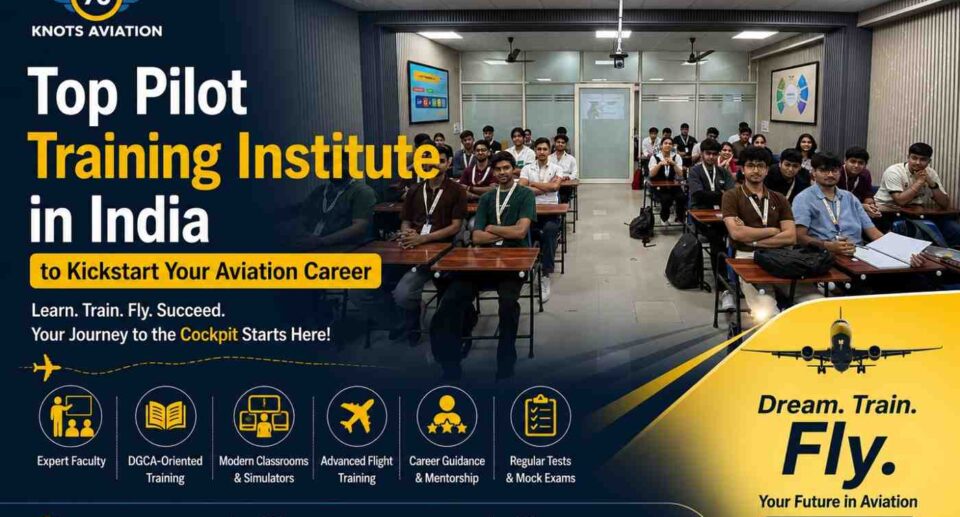
Top Pilot Training Institute in India to Kickstart Your Aviation Career
With the rapid growth of India’s aviation sector, many aspiring pilots will get the chance of their lifetime to fly all over the world. The expansion of new terminals means that the demand for new flight crew members has never been higher. Choosing the right training program is the most crucial step to help you build your career in aviation. Flying school searches are very common. Searches for the best pilot training school, best flying school, and top flying schools in India are many. At 70 Knots Aviation, we believe passionate future pilots are people we can help by building their skills and knowledge with confidence using our tools and structured and industry oriented training to help them reach their goals.
Becoming a successful pilot is a journey. It requires all of the building blocks: education, preparation, discipline, guidance, and of course, practical experience. The right training school will help you build a solid foundation for each of those building blocks.
Importance of Choosing the Right Aviation Training School
Training to be a pilot is so much more than flying an aircraft. It is an opportunity to build your knowledge in technical skills and much more like the skills of communication and the art of making sound judgment that are coupled with an understanding of the various codes that govern flying.
One of the leading Pilot Training Institute in India has many advantages to students.
These include:
- Aviation Instructors with Extensive Experience
- Training in Conformity with the DGCA
- Modern Learning Infrastructure
- Comprehensive Ground Classes
- Professional Flight Training
- Frequent Tests and Mock Exams
- Career Guidance and Mentorship
All of these prepare students for the DGCA exams and for flying professionally.
An Overview of Pilot Training in India
Pilot training consists of two major components.
Ground Training
Ground training is the beginning stage of training and is conducted in ‘ground school.’
During ground school, students learn:
- Air Navigation
- Aviation Meteorology
- Air Regulations
- Technical General
- Radio Telephony
- Flight Planning
- Aircraft Systems
- Aviation Safety
Having an excellent foundation of theory assists students immensely for success in flight training.
Flight Training
Students begin this training after the completion of ground school.
This training is comprised of:
- Basic flying
- Take-offs and landings
- Navigation flights
- Solo flights
- Instrument flights
- Cross-country flight
- Emergency procedures
Both theory and practical training are critical for success in the profession of flying.
The Leading Pilot Training Institute in India
The selection of the right aviation academy is of great importance.
Experienced Staff
Trained staff renders complex subject matter easy to understand.
Their vast knowledge of aviation will assist students in understanding the many facets of aviation instead of having reliance on the theoretical aspects.
DGCA Oriented
The systematic nature of the curriculum shows students every aspect required for completion of the DGCA.
This promotes learning and reduces the stress of the unknown.
Modern Learning
The leading aviation academies have:
- Smart Classrooms
- Digital and Interactive Learning
- Aviation Simulations
- Current Learning Materials
Professional learning environments enhance the enthusiasm to learn among students.
Individual Student Support
Students have their own individual learning preferences.
Alongside helping students address weaker areas, personalized mentoring improves academic performance.
Regular Mock Tests
Mock tests help familiarize students with DGCA’s exam pattern.
Mock tests also help improve:
- Knowledge of subjects
- Confidence
- Speed
- Time management
- Accuracy
Success in an exam is a result of considerable amount of practice.
How to Become a Professional Pilot
Many students want to know how to achieve a successful career in aviation.
Generally, there is a pathway to follow.
Complete Basic Education
Students should complete the necessary schooling with inclusion of Physics and Mathematics, which is recommended for someone wanting to become a commercial pilot.
Enroll in a Top Pilot Training Institute
Enrolling in the Top Pilot Training Institute in India ensures that students are taught by industry professionals.
Complete Ground Classes
Before taking practical lessons, students learn the theory of aviation.
Ground training is the teaching of concepts necessary for the safety of aviation.
Clear DGCA Exams
DGCA exams are the assessments of a student’s theoretical knowledge of aviation.
Clearing this exam is a mandatory step in the process of obtaining a Commercial Pilot License.
Complete Flight Training
This is the training that provides students with the necessary flight time.
This training also consists of drills that cover the various flight operations that a professional pilot would undertake.
Acquire the Commercial Pilot License
Once students have successfully completed training and the DGCA formalities, students become eligible to receive their Commercial Pilot License.
Best Pilot School in India
The best pilot schools in India are not what they appear to be in promotions.
A good institute emphasizes the value of disciplined training in the development of a good quality professional pilot.
Essential Features
Skilled Instructors
Instructors with extensive professional experience help students at every stage of their aviation development.
Modern Study Resources
Aviation education is a developing field. Study resources are revised regularly so students are prepared with the latest resources per the DGCA guidelines.
Learning Enhancement
The best institutions aim to improve understanding of the subject rather than rote learning.
Professional Assistance
Students are offered professional help for interviews, selection for airlines, and their future career plans.
Positive Attitude
The best flying schools help students maintain a positive attitude during their flying training.
Topics During Pilot Training
The best schools of aviation have flying professional courses that cover the following topics.
Aviation Navigation
Students familiarize themselves with:
- Navigation charts and Flight planning
- Compass systems
- Time-speed-distance calculations
- Radio navigation
Practice enhances the skill of navigation.
Aviation Meteorology
Students learn about clouds, winds and pressure, along with forecasting visibility and turbulence. A better understanding of weather aids the improvement of the operational decision processes.
Air Regulations
Knowledge of aviation laws, regulations, and required daily flight rules, along with ICAO requirements and safety air procedures, is retained by students with periodic review.
Technical General
Knowledge of aircraft systems and engine operation along with the integral systems of flying is of aiding safety.
Radio Telephony
Knowledge of communication procedures with ATC and the required Standard phraseology for every communication is emphasized during training.
Why Students Look for the Best Flying Schools in India
Every student learn and desire the best flying training and resultant career opportunities.
Besides wanting professional training, students searching for the best flying schools in India also want:
- Faculty with professional and industry recognition
- Curriculums with up-to-date information
- Academic and practical support for aviation
- Practical and supportive assistance for building a career
Selecting the best institution will build your foundation for a successful career.
What You Should Know When Choosing a Pilot Training Institution
Believe only a little of the ads when selecting a pilot training institution.
- Look for schools that support both the theoretical and practical components of aviation training.
- The quality of education and training in the institution will rely heavily on the classroom and aviation educational resources.
- Continuous mentoring helps students remain focused and motivated during the entire training session.
- Institutions that conduct regular mock examinations are likely to enhance a student’s performance in the DGCA examinations.
- Schools need to offer training that will assist students to get employment with an airline once they have obtained their license.
Why Discipline is Important During Pilot Training
The aviation training that a pilot undergoes demands a lot of commitment, and the successful trainees develop habits like:
- Studying daily
- Practicing professional discipline
- Maintaining a positive attitude
- Consistently arriving on time and ready to engage
Habits developed during training will also be essential to a pilot during the rest of their working life.
What You Can Do After You Become a Pilot
Education from the Best Pilot Training School in India will open doors to many career choices.
- Joining a commercial airline
- Becoming a First Officer and then Captain on a commercial airline
- Enjoying a career in charter aviation, where you operate a chartered aircraft for private clients and corporates
- Becoming a cargo airline pilot, as cargo airlines are rapidly evolving due to logistics and e-commerce
- Enjoying a career in business aviation, as the field of business aviation offers many lucrative opportunities for a professional pilot
Flight Instructor
As a Flight Instructor, you can accumulate experience for your subsequent career as a Commercial Pilot.
Why 70 Knots Aviation
The right institute is a pivotal choice in your aviation career.
At 70 Knots Aviation, we have a focus on high quality aviation instruction, utilising structured and facilitated classroom teaching, quality and relevant faculty, up to date learning resources, and ongoing mentoring of students. Each training programme is tailored to enhance conceptual knowledge, alongside the preparation of students to undertake the DGCA exams and professional flight training.
The students have the advantage of study plans, time management skills, frequent and rational learning activities that enhance their knowledge of aviation and result in good academic performance. At 70 Knots Aviation, we have the conviction that the essential components to a successful professional pilot career are quality guidance, and practice brought forth by self-discipline and preparation.
Common Mistakes Students Make
Many students fail due to mistakes that are often avoidable.
Some of the most common mistakes are:
- Not preparing in time
- Ignoring what they are weak in
- Thinking they can pass by memorizing
- Not revising
- Not doing practice exams
- Poor time management
- No self-discipline regarding studies
Avoiding these mistakes will help you perform better in your exams.
Comparison of Top 10 Flying Schools in India
In most cases, students do a comparison of the Top 10 Flying Schools in India prior to choosing an institute for their aviation training.
Some of the things they look at include:
- Experience of the faculty
- Quality of the training
- The learning environment
- Reviews given by previous students
- Quality of the infrastructure
- Quality of the ground training
- Quality of career guidance offered
Informed choices for their aviation training are possible due to thorough comparisons.
Why There Is a Comparison of the Top 10 Pilot Training Institutes in India
Many of the aspiring pilots are also looking to see which of the institutes are in the Top 10 Pilot Training Institutes in India with Fees, to get a feel for the investment that is needed to become a pilot.
The following factors should also be weighed alongside cost:
- The training you will receive
- The support you will get
- The services they offer
- Future aspect
Choosing an Airline based on cost alone can mean you do not receive the training you need to be safe and successful in the aviation industry. More often than not, safety and Aviation go hand in hand.
Tips to Help You Succeed
Students who have the best marks seem to be the most disciplined.
This includes:
- Daily study
- An organized approach to education
- Constant revision
- Practice problems
- Absence of class excuses
- Inquiries
- Mock exams
- Emotional and physical fitness
- Stay inspired throughout
Training and studying consistently always betters the final outcome, along with the daily routine.
The Direction of the Aviation Industry in India
India is the most rapidly growing aviation market around the world.
Some of the reasons include:
- Airlines increasing their fleets
- Higher demand for domestic air travel
- An increase of regional travel
- Airfreight operations
- More airports
- A greater need for pilots
All of these factors will create more job opportunities for pilots and will attract a higher demand for better programs.
Conclusion
The first step toward a fruitful aviation career is determining the Best Pilot Training Institute in India. Preparation in the aviation industry demands an educated workforce. Top aviation schools in India offer programs staffed by seasoned instructors and include training and mentorship offered over the school’s duration. Finding the best aviation schools in India, assessing lists ranking the best flying schools in India, or finding the best aviation training schools in India by their price is going to be a time-consuming task but should be based on the long-term career opportunities and not on considerations of the training program’s duration and cost.
70 Knots Aviation strives to enhance the dream of aspiring pilots by offering high training standards, preparing them in a disciplined manner, and providing expert assistance. Quality training offers aspiring pilots the best prospect of building their dream aviation career.
FAQ
1. Which is the best pilot training institute in India?
The best pilot training institute in India offers DGCA-approved training, experienced instructors, modern infrastructure, comprehensive ground classes, flight training, and strong placement support to help students build a successful aviation career.
2. How do I choose the best flying school in India?
Choose a flying school based on DGCA compliance, faculty experience, aircraft fleet, simulator training, student reviews, safety standards, and career guidance rather than only comparing course fees.
3. What is the eligibility to join a pilot training institute in India?
To join a pilot training institute in India, candidates generally need to have completed 10+2 with Physics and Mathematics, meet the required medical standards, and satisfy the DGCA eligibility criteria.
4. How much does commercial pilot training cost in India?
The cost of Commercial Pilot License (CPL) training varies depending on the institute, aircraft availability, and flight hours. Students comparing the Top 10 Pilot Training Institute in India with Fees should also evaluate training quality and placement support.
5. What career opportunities are available after completing pilot training?
After completing pilot training and earning a CPL, graduates can pursue careers as airline pilots, charter pilots, cargo pilots, corporate pilots, flight instructors, or eventually progress to airline captain after gaining experience and qualifications.
The 70Knots Aviation team shares informative and practical insights on pilot training, aviation careers, DGCA requirements, CPL training, flight training, and the Indian aviation industry. Through well-researched articles, the team aims to help aspiring pilots, aviation students, and aviation enthusiasts understand training pathways, eligibility, courses, and career opportunities in aviation. As one of the best pilot training institutes in India, 70Knots Aviation provides clear and useful information to support readers at every stage of their journey toward a career in the skies. With a focus on practical aviation knowledge, the team brings together valuable insights to help readers make informed decisions about their aviation education and career.