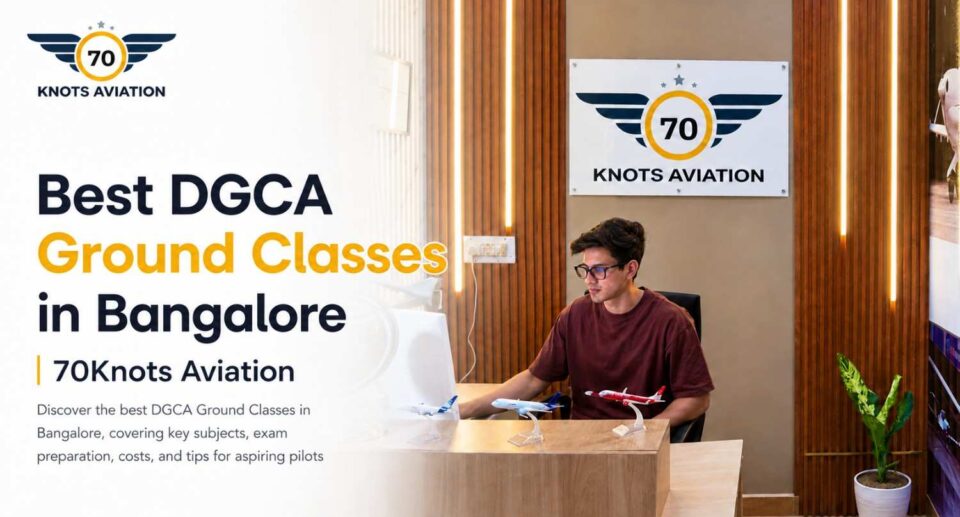
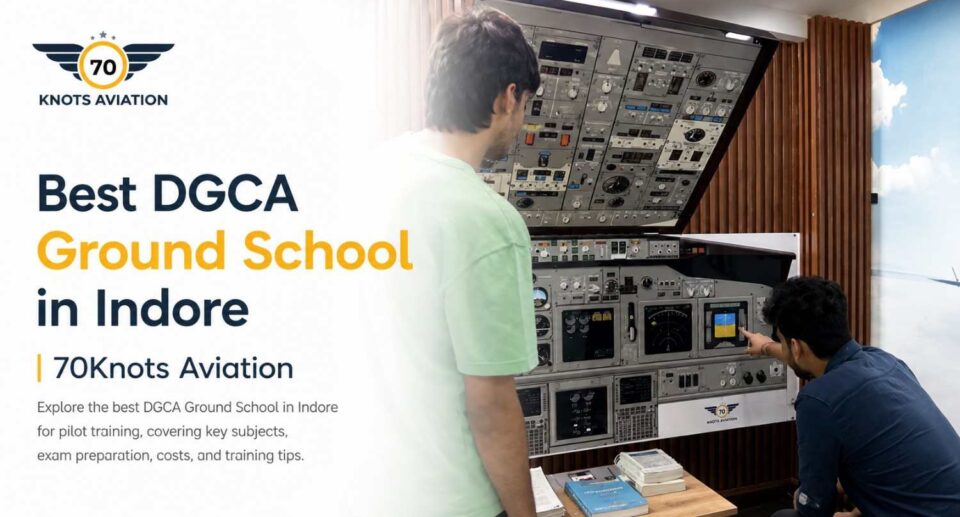
Best DGCA Ground School in Indore
For pilots-in-training, choosing the right ground school becomes one of their earliest and vital steps to forging an aviation career. Prior to undergoing flight training, the trainees need to learn a lot about aviation theories, aviation regulations, navigation, weather, aerodynamics, and communications.
One of the well-known DGCA Ground Schools in Indore is one of those institutes that can prepare the students well with aviation theories and help them qualify the pilot training tests. Indore has developed into a city that focuses on education and allows students to further pursue their studies in professional aviation.
While many students focus solely on the costs of ground school, the quality of instruction, faculty, study materials, exam preparation, and extraordinary support are just a few components that differentiate one ground school from the next.
Among the various training options available, 70Knots Aviation provides DGCA CPL and ATPL ground training and covers the theory of Air Navigation, Aviation Meteorology, Air Regulations, Technical General, and RTR preparation.
Understanding DGCA Ground School
A DGCA ground school focuses on the theoretical aspect of becoming a professional pilot and outlines the theory and principles behind the operations that students will carry out on a flight.
Flying an aircraft is a much more complex undertaking that requires a great deal of knowledge of weather, navigation, meteorology, and understanding of the principles and regulations of the operation.
Ground training places students in an organized academic environment. Students can engage in several training activities including scheduled lectures, practicing examination questions, reviews, and clarification of ambiguities.
Answers to exam questions should not be the only objective. An effective ground training school will ensure that students appreciate the fundamentals of the questions. This aids the students in retaining the information during the flight training and throughout their professional aviation duties.
Pilot Ground Training in Indore
Considering Indore’s educational infrastructure, it is a good choice for students that want to initiate their aviation studies without having to relocate to bigger and more modern cities.
While looking at ground school options in Indore, students should assess the offered programs. The location of the city may be convenient, but this should not compromise the academic quality.
The student should examine the duration and structure of the course, the study resources, classroom layout, a series of mock examinations, clarification of ambiguities, and the provision of guidance for examinations.
Students should also understand the difference between ground training and flying training. Ground training aids the students academically, and flying training much later is done through an appropriate Flight Training Organisation.
What Are the Different Areas Covered in DGCA Ground Training?
For different licensing paths, and depending on the current regulations, DGCA ground training covers different areas of aviation theory.
Air Navigation
Air Navigation tutors students on how to navigate an aircraft from one point to another. This typically covers charts, headings, tracks, coordinates, distances and times, flight planning and navigation.
Many students struggle initially with concepts of navigation since it combines the mastery of multiple theories and the application of mathematical formulas. Hence, constant practice is very crucial.
Instead of attempting to memorize answers, students should understand the effect of various influencing parameters on navigation. This approach will simplify answer preparation for the exams and also practical flying.
Aviation Meteorology
The effect of weather on flying is considerable. Aviation Meteorology teaches students about the various atmospheric and weather conditions that can influence flying operations.
This unit focuses on the atmospheric elements of pressure and temperature, wind, clouds and visibility, thunderstorms, and icing.
Good instructors will explain these elements of weather in the context of flying, since understanding the reason for concern about the weather is more important than memorizing the definitions.
Air Regulations
This unit deals with the rules and orders that govern aviation operations.
Since aviation regulations contain a lot of specific terms, this area also requires meticulous study. It is important that students appreciate the significance of studying and clearly comprehending the regulations.
Technical General
This section deals with the systems, engines, aerodynamics, instruments, and other technical elements of aircraft.
Students should especially focus on the interconnection of these systems, for this will especially serve them when commencing practical training.
Radio Telephony
Communication is a big part of flight operations. Pilots need to communicate with air traffic control and other concerned personnel following the procedures that are prescribed.
RTR course information explains aviation communication concepts and vocabulary.
70Knots Aviation has RTR published on its website as an aviation course also including Air Navigation, Aviation Meteorology, Air Regulations, and Technical General.
What Should You Look for in a DGCA Ground School?
There are several factors to consider when choosing a DGCA Ground School in Indore.
The quality of the teaching faculty is of paramount importance. Aviation can be a difficult subject and can become quite complex for students when they begin to learn navigation, systems, and regulations. Clear and concise instructors can aid in streamlining the learning process.
The structure of the course should not be overlooked either. The student needs to know which topics will be studied, and how classes and revision for exams will be included in the course.
A high-quality set of course materials will help in systematic revision for students who have structured course notes, practice questions, example exams, and revision materials.
Support for clearing doubts is essential. Practice during class may help students to understand a concept, but difficulties with a concept may be felt when attempting questions independently.
Transparency in a course regarding duration, cost, course materials, class structure, exams, and much more should be of utmost concern to students.
Concept-Based Learning vs Recall
Perhaps the greatest pitfall of aviation education is the temptation to memorize answers to problems.
Certain types of problems can be resolved with memorization, like some facts or regulations, but wisdom and understanding are critical.
A situation can occur during a flight where things are not like those described in the book; and knowing how to use the information will solve the problem.
In order to learn navigation, students must be aware of heading, track, wind, distance, and time. In order to learn meteorology, students must know how to analyze the effect of weather conditions on flight operations.
Students should prefer a teaching environment that focuses on questions, examples, discussions, and revision.
Students who have a good understanding of the fundamentals can also complete future training with less difficulty as they understand most of what they learn while in the aircraft.
How 70Knots Aviation Supports Aspiring Pilots
70Knots Aviation provides ground training for the DGCA CPL and ATPL examinations. According to the academy’s website, 70Knots Aviation provides ground training and structured aviation education for aspirants.
The academy’s listed training areas include Air Navigation, Aviation Meteorology, Air Regulations, Technical General, RTR, ATPL preparation, and airline preparation. The academy also states that it provides training based on concepts, online and offline training, quizzes, and doubt-clearing sessions.
For students looking for a DGCA Ground School in Indore, 70Knots Aviation is an option for the ground training component of the student’s pilot training.
Students are advised to confirm directly with the academy on available courses, formats, schedules, fees, and other program specifics before enrolling.
Ground Training and Flight Training Are Different
A good number of new students in the aviation field believe that ground school and flight training are similar.
They are not.
Ground school comprises theory. Students learn navigation, weather, regulations, systems, and communications.
Flight training includes practical training on the operation of aircraft. From flying an aircraft to both take-off and landing, performing various maneuvers and navigation, communicating, understanding how to operate an aircraft in an emergency, etc., are some of the skills practicing flight instructors help students develop through practical training.
The relationship between both the aspects is symbiotic. While practical flying develops an understanding of the theoretical concepts, strong command of the subject helps students appreciate the theory behind the practical skills developed.
For a pilot trainee, it is crucial to plan both aspects of the training carefully.
How to Prepare for DGCA Examinations
The most important aspect of any examination preparation is being consistent. It is better to have a planned study schedule than relying on the last-minute rush. Knowing the structure of the subjects and the amount of practice and revision each subject requires is the key to a successful examination.
Navigation in particular requires a lot of practice with numbers. Thorough reading and revision of regulations is a must. Diagrams, examples, and practical strips are a must for technical subjects.
Mock tests also help gauge the level of preparation. Rather than checking just the scores, students are expected to go through the answers to those that they got wrong in order to determine the topics on which the focus of their preparation ought to be.
It is also important to have well-prepared and structured notes on the various topics throughout the course.
Understanding the Cost of Pilot Training
The monetary implication of becoming a pilot extends beyond the ground school fee. It also involves the cost of the medical examination, the DGCA examination, study material, traveling, accommodation, training flights, licensing, and other associated costs.
Training on the ground forms only a small component of the entire process of becoming a pilot.
To prepare a financial plan that accounts for the total cost of training is vital, and students must speak to training providers for clarity on the total cost and what is covered in the fee.
There are several variables that may influence the cost of training such as weather, flying hours, progress in training, etc.
How Long Does Ground Training Take?
Completion time for ground classes may vary for different institutions, how the classes are structured, how quickly students master the course content, and how frequent classes are scheduled.
Shorter classes should not be perceived as better classes. Students should be given ample time to master the content, practice samples, and clear any doubts they might have.
The focus should not be on completing classes as quickly as possible, but on the effectiveness of preparation.
Students should enquire about the number of sessions used for instruction, how revisions are conducted, if mock examinations are conducted, and how the students who struggle to master a certain subject are assisted.
Common Mistakes Aspiring Pilots Should Avoid
- Not doing enough research before joining a flight training school: Students should research the training provider, course structure, faculty, resources, fees, and practical training arrangements before making a decision.
- Ignoring the importance of instructors: Instructors should be seen as valuable resources that support the learning process and development of aviation knowledge.
- Using a memorization-focused approach: Students should focus on understanding aviation concepts rather than simply memorizing answers.
- Confusing ground school with flight training: Completing ground school does not equate to completing practical flight training.
- Using old data: DGCA can change its requirements and testing framework. Before making decisions, candidates need to confirm the latest information on the DGCA website.
Long-Term Aviation Career
Ground training is the start of the formal education of a professional pilot.
After the mandatory training and practical experience, and depending on the license and duties, pilots can pursue a job in airline operations or in related sectors such as charter aviation, cargo operations, corporate aviation, or flight instruction.
However, candidates must keep a realistic perspective. Just having a license does not ensure a position in an airline. Industry conditions and the recruitment policy of an airline dictate the results of job offers.
The studies carried out during ground training have long-term value. The employment of these habits, including discipline and consistency, along with good communication and understanding of the fundamentals of the profession during the training can be of immense value on the job.
Frequently Asked Questions
What is a DGCA ground school?
These schools offer theoretical training in aviation. Subjects include navigation, meteorology, regulations, technical subjects, and communication.
Is Indore a good place to study pilot ground training?
It is one of the many good locations you can consider for aviation ground training. Candidates must research institutes to determine curriculum, faculty, study resources, and the number of examinations offered.
What is the curriculum in DGCA ground school?
Typical subjects include Aviation Navigation, Aviation Meteorology, Aviation Regulations with a focus on Technical General, and RTR preparation related to the candidate’s license and examination requirements.
Does 70Knots Aviation offer DGCA ground training?
Yes, 70Knots Aviation offers DGCA CPL and ATPL ground-training programs and includes the subjects of Air Navigation, Aviation Meteorology, Air Regulations, Technical General, and RTR.
Is DGCA ground training similar to flying training?
The two are different. Ground training is theory-centered, while flight training is centered on learning how to fly. Both serve different functions in the field of professional flying.
How do I choose a ground school?
Compare the faculty, course material, structure of the classes, study materials, practice tests, how they support the clearing of doubts, the fees, and the overall approach of the ground school to preparing students for the examinations.
How much does pilot training cost?
The answer depends on the total cost of ground training, flight training, medical expenses, examination costs, boarding and lodging, licensing, and other costs. Students should ask for a detailed breakdown of the cost before starting the training.
How long does DGCA ground training take?
The length of time to complete the training varies from one training institute to another, based on the course structure, examination schedules, and the student’s progress. The goal should not be to complete the training in the shortest possible time, but to learn well.
Conclusion
Choosing the best DGCA Ground School in Indore allows an aspiring pilot to begin his or her aviation education on a good footing. The ground-training programs that successfully prepare students to answer questions on the examination and to develop the knowledge that will be useful when the student begins practical flight training are the best.
In deciding which ground school to attend, students should not base their decision on the cheapest option or on the ground schools that advertise the most. In such a case, faculty experience, clear and effective instruction, adequate study materials, practice exams, doubt-clearing services, and preparation of students for the exams are the most important aspects to consider.
70Knots Aviation provides DGCA CPL and ATPL ground training and covers various aviation topics in its programs that help students prepare for exams.
Regardless of where the student starts ground training, whether in Indore, Delhi, or other cities, the objective is to understand the theory of aviation, to prepare consistently, and to have a disciplined and realistic approach to each phase of the training.
The 70Knots Aviation team shares informative and practical insights on pilot training, aviation careers, DGCA requirements, CPL training, flight training, and the Indian aviation industry. Through well-researched articles, the team aims to help aspiring pilots, aviation students, and aviation enthusiasts understand training pathways, eligibility, courses, and career opportunities in aviation. As one of the best pilot training institutes in India, 70Knots Aviation provides clear and useful information to support readers at every stage of their journey toward a career in the skies. With a focus on practical aviation knowledge, the team brings together valuable insights to help readers make informed decisions about their aviation education and career.