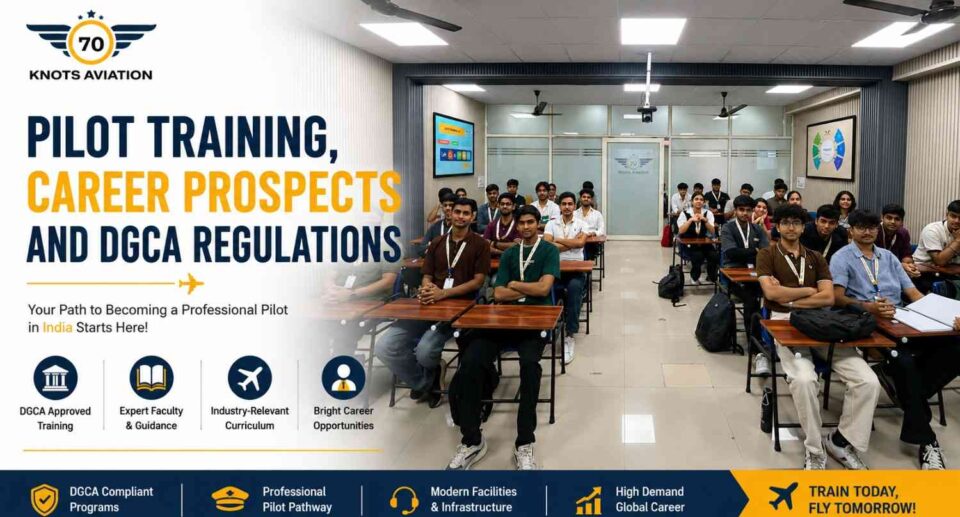
Pilot Training, Career Prospects and DGCA Regulations
For many students, the dream of a successful career in aviation starts with a love of flight. Becoming a commercial pilot brings the joys of travel on the job and the ability to work with the world’s best airlines to the career of a professional pilot.
Planning and dedication to the required training and regulations are essential to becoming a pilot. Serious students will assess the qualifications, the regulations and restrictions of the aviation industry, the training requirements, the assessments, and the career pathways of a pilot before embarking on this dream career.
The process of becoming a pilot in India is governed by the Directorate General of Civil Aviation (DGCA). Those seeking a pilot’s license must complete the requisite training, pass the required assessments, and acquire a prescribed level of flight experience.
In this document, we outline the steps to obtain your pilot’s license and complete a commercial pilot’s course in India, we describe the Pariksha DGCA and provide insights that will assist you in estimating the costs of pilot training.
Pilot Career Path in India
Flying is just one of the many duties of a professional pilot. The profession requires a depth of knowledge on a variety of subjects, the ability to make sound judgements and decisions, the discipline to adhere to regulations, and the ability to assess safety and risk in a variety of situations.
Commercial pilots will endeavor to complete the required educational qualifications, undergo the required medical assessments, and complete the training prescribed by a recognized aviation training organization. This will include ground training, the DGCA assessments, and flight training.
There is a demand for trained aviators in the growing Indian aviation industry. Expanding airlines create the need for a greater workforce of qualified professionals.
The right training institute can make or break your career as a pilot. A good training institute will have all the resources you need including instructor guidance, DGCA exam prep, and other resources to support your training.
Pilot Training Eligibility in India
There are a onboarding requirements you have to meet before you are eligible to start pilot training.
Education Requirements
The first eligibility criteria is education. If you want to get admission to a flight training program, you must have completed your higher secondary education with Mathematics and Physics.
If you did not complete your 10+2 with Mathematics and Physics, you can complete those through recognized means. However, you will need a rudimentary knowledge of Physics and Mathematics in order to understand a lot of the concepts you will come across in aviation training.
Age Requirement
You must also meet the age requirements for the licenses you intend to obtain. Many students begin planning their pilot training before they have met the age requirements. You can also start your training once you meet these requirements.
Medical Fitness Requirement
Aviation also has medical fitness requirements. There are a number of aviation medicals that must be passed in order to have your pilot license.
There are a number of factors that will also be assessed but the fitness requirements for pilots includes maintaining a good state of physical and mental health.
How to Become a Pilot
One of the most informative resources prospective pilots search for, is how to become a pilot, as it is a detailed and structured illustrative guide they can reference when they embark on their pilot training.
Becoming a pilot entails a number of different stages and steps to become qualified and licensed as a pilot.
Step 1. Finish your 10+2 Education
Finish your 10+2 Education with the necessary subjects. Students should be academic in the subjects of Math and Physics. These subjects become the building blocks to understanding the fundamental concepts of Systems and Operations.
Step 2. Select a Professional Aviation Institute
The selection of a good aviation institute is one of the vital decisions an aspiring pilot would have to make in their lifetime.
When selecting an aviation institute, students should consider:
- DGCA Approved Programs
- Qualified Instructors
- Ground School Classes
- Flight School
- Career Services
70Knots Aviation is a distinguished institute, that familiarizes the students with all the phases of pilot training, aviation testing, and professional opportunities.
Step 3. Complete DGCA Ground Training
Prior to their initial flight training, students must complete DGCA Ground Training.
This training, along with flight safety, assists instructors in grounding their understanding of flight operations and safety.
Subjects include:
- Air Navigation
- Aviation Meteorology
- Aircraft Technical Knowledge
- Air Regulations
- Flight Planning
Step 4. Pass DGCA Exams
Following Ground Training, students must pass DGCA exams to certify that they possess the requisite technical knowledge regarding the subjects of Aviation.
Extensive preparation is paramount because DGCA examinations test the understanding of concepts related to aviation rather than testing the ability to memorize.
Step 5: Flight Training Hours
The incomplete Flight Training hours mark an important gap in Practical flying experience.
Candidates learn about aircraft handling, the procedures for take-offs, landings, navigation, and the management of emergencies.
Step 6: Obtain a Pilot License
Candidates are then able to obtain the relevant Pilot License.
Even after obtaining a Pilot License, there is scope to develop skills and participate in other avenues of aviation.
Commercial Pilot Training in India: Deep Dive
Throughout the duration of training, candidates are required to learn working knowledge of flight operations.
A Professional commercial pilot training in India Course consists of:
Ground School Training
Ground School Training focuses on the theoretical knowledge of flying and the regulatory framework.
Candidates learn about Aircraft, Elements of Weather, How to Navigate, and Aviation Safety.
Practical Flight Training
Flight Training provides the opportunity to learn in an environment that has a reliance on the theoretical knowledge learned in Ground School.
Candidates learn the flying skills and develop the confidence to take to the skies under the watchful eye of a qualified Flight Instructor.
DGCA Examination Preparation
Aviation institutions help candidates to prepare for the DGCA examinations in a structured manner.
The correct guidance allows students to comprehend the examination structure and formulate a greater chance of success.
Endless opportunities await in aviation after candidates have completed Commercial Pilot Training.
Here are some examples of potential careers in aviation.
- Commercial airline pilot
- Flight instructor
- Charter airline pilot
- Aviation operation roles
- Corporate airline pilot
The aviation industry is an excellent field for those wanting a profession with career growth.
Reasons Why Pariksha DGCA is Important for Pilot Aspirants
Pariksha DGCA is a significant resource for those who want to work hard and focus on passing the DGCA exams.
The DGCA exams are essential for a pilot’s formal training process. The DGCA certified exams are the first step in a pilot’s formal training to determine if the pilot understands the essential elements of the profession.
Subjects Related to the DGCA Exams
Those preparing to take the DGCA certified exams should learn the following aviation subjects.
- Air Navigation
- Aviation Meteorology
- Air Regulations
- Technical General
- Technical Specific
All of the above listed subjects require a thorough understanding for the DGCA exams.
Tips for Preparing for the DGCA Exams
It is very important for the student to have a proper study plan to prepare for the DGCA exams.
The quality of preparation can be enhanced by practicing the subject on a regular basis and by having revisions and guidance by an expert.
Complex subjects must be simplified to the student, professional training institutes provide a service to the aviation students to prepare for the certification exams.
Understanding Pilot Course Fees in India
An exceedingly common topic of discussion in the aviation community is the pilot course fees structure.
The cost of a pilot’s formal training is variable. The training institute, the type of aircraft, the location, the number of flying hours, and the other logistical requirements influences the cost of pilot training.
Pilot Training Cost Variables
There are multiple components that significantly affect the overall cost of pilot training.
These factors are inclusive of:
- Flight training hours
- Rental charges for aircraft
- Ground school fees
- Charges for DGCA examinations
- Medical examinations
- Costs for processing licenses
- Location of training
Careful and thorough research on the training institutes and on the components of each cost is essential before embarking on the aviation journey.
Importance of Training Quality
Training quality is as important as the cost of the training, and should be the focal point of the student.
An aviation institute that maintains high standards and offers skilled mentoring and directional support can be the launching pad of a successful piloting career.
Why 70Knots Aviation
Direct piloting career support and the highest industry standards and skilled level of mentoring are the cornerstones of the training that 70Knots Aviation offers.
Many students are confused when it comes to the procedural and regulatory training framework support, guidance on the DGCA requirements, the type of examinations, as well as career advancement.
70Knots Aviation offers students:
- Support with DGCA exam preparation
- Aviation career counseling
- Ground training
- Pilot career planning
- A professional training environment
The degree of support and preparation that aspiring aviation professionals enlist helps them to advance and realize their ambitions of professional piloting.
The Future Lies In Aviation
With the number of pilots and job positions becoming higher due to the rise in the need for flights.
The learning of aviation never stops, and having a growth mentality is an important attribute of a successful pilot.
Pilots who start their aviation career with proper preparation have a much better chance of achieving success.
Answers To Common Questions On Becoming A Pilot
What is the process to become a pilot after 12th?
12th pass out students with Physics and Mathematics can become pilots by taking pilot training after enrolling in a recognized flying school. All DGCA clearances, examinations, and flight training would be necessary.
What constitutes commercial pilot training in India?
Commercial pilot training in India involves ground school training, DGCA examinations, flight training, and licensing procedures.
What is Pariksha DGCA?
Pariksha DGCA is an online portal that has been created for the benefit of students who are appearing for DGCA aviation examinations in order to fulfill one of the requirements of a flying school.
How expensive is pilot training in India?
The cost of pilot training depends on various factors including the number of flying hours, the school itself, the plane, and the cost of examinations. Candidates are encouraged to do a cost analysis of the training programs they are interested in.
Is preparation for DGCA Examinations a prerequisite to pilot training?
Yes, preparation for the DGCA Examinations is mandatory for pilot training because candidates must clear the examinations to obtain the pilot license.
Am I eligible to become a pilot after my graduation?
Yes, pilot training can still be pursued as post graduation as long as the eligibility criteria are met. The training process will be the same and will be based on DGCA requirements, Examinations, and flying hours.
The 70Knots Aviation team shares informative and practical insights on pilot training, aviation careers, DGCA requirements, CPL training, flight training, and the Indian aviation industry. Through well-researched articles, the team aims to help aspiring pilots, aviation students, and aviation enthusiasts understand training pathways, eligibility, courses, and career opportunities in aviation. As one of the best pilot training institutes in India, 70Knots Aviation provides clear and useful information to support readers at every stage of their journey toward a career in the skies. With a focus on practical aviation knowledge, the team brings together valuable insights to help readers make informed decisions about their aviation education and career.